Category

Property

Website of the Month: Seven Steps to Becoming a Successful Landlord

By | Property, Website of the Month
“Landlords grow rich in their sleep” (John Stuart Mill)
Earning passive income as a landlord is an attractive proposition which can generate substantial wealth, but before you rush into anything be sure to know exactly what you are doing. “From homeowner to landlord: how to make it work” on Tech4Law shares six important steps on ensuring that you get the most out of your new venture. We’ll add a seventh (critical) step – the earlier on in the process you ask your lawyer for advice, the better. No one is better placed to explain the legalities, to make sure you have all the right paperwork, to help you maximise the benefits, and to protect you from the risks. Disclaimer: The information provided herein should not be used or relied on as professional advice. No liability can be accepted for any errors or omissions nor for any loss or damage arising from reliance upon any information herein. Always contact your professional adviser for specific and detailed advice.

© LawDotNews

12 Questions to Ask Before You Sign That Deed of Sale

By | Property, Uncategorized
“Knowledge is power” (old proverb)
Whether you are buying or selling property, remember that it is too late to ask questions after you sign the Deed of Sale (often called a “Sale Agreement” or “Offer to Purchase”). “Knowledge is power” rings particularly true when it comes to any form of process with significant legal consequences, so here are some of the important questions you should ask upfront, before you commit to anything –
  1. What do all the terms and conditions (particularly the legal-speak bits) in the Deed of Sale mean in practice?
  2. Are my rights adequately protected and my risks minimised by the terms and conditions?
  3. What costs will I have to pay, and when?
  4. Is there anything in the Title Deed or local municipal laws and zoning restrictions that may impact me (as a buyer)?
  5. Do I (as buyer) have a copy of the plans, and have all extensions and alterations been authorised by the local authority?
  6. What defects have been disclosed in the Mandatory Disclosure Form, is a home inspection report worthwhile (and permitted by the deed of sale), what is the legal position around voetstoots clauses and patent and latent defects, and does the Consumer Protection Act apply to this sale?
  7. As a buyer, have I checked for practical issues like local fibre availability, crime levels, security, school feeder zones, fixtures and fittings to remain, work-from-home practicality, buy-to-let possibilities etc?
  8. Are there tenants (or other occupants) in the property, and if so what is their status and what does the deed of sale say about when they will vacate?
  9. When does the buyer take possession and occupation? (Careful here, possession and occupation are two different concepts in law)
  10. What arrangements have been made for date of transfer and payment of occupational interest, rates and taxes, levies, municipal service charges and the like?
  11. In a residential complex: As a buyer, what Rules and Regulations will I be bound to, is there a danger of a special levy being levied, and do the latest financial statements for the Body Corporate or Homeowners Association show a healthy financial situation?
  12. Have I as seller appointed my choice of conveyancer (transferring attorney)?
A final but vital thought here – whether you are buying or selling property, a lot of your money will be at stake here. Get professional advice before committing yourself to anything! Disclaimer: The information provided herein should not be used or relied on as professional advice. No liability can be accepted for any errors or omissions nor for any loss or damage arising from reliance upon any information herein. Always contact your professional adviser for specific and detailed advice.

© LawDotNews

Website of the Month: Solar Power and the Insurance Risk

By | Property, Website of the Month
With our loadshedding woes unlikely to go anywhere soon, more and more property owners are looking to solar power as an alternative to relying on Eskom. Just be careful that you don’t fall foul of your insurers in the process. “Rules homeowners should know before installing solar power” on MyBroadband lists four technical regulations to be particularly aware of. For some practical advice on deciding whether or not to go the solar route in the first place, and if so how, read another MyBroadband article “What you should know before installing solar panels and batteries at your home” here.  Keep an eye also on the developing story around proposed new Eskom tariffs and “feed-in” tariffs. Disclaimer: The information provided herein should not be used or relied on as professional advice. No liability can be accepted for any errors or omissions nor for any loss or damage arising from reliance upon any information herein. Always contact your professional adviser for specific and detailed advice.

© LawDotNews

Buying and Selling Property: Who Pays What Costs?

By | Property
“Risk comes from not knowing what you’re doing” (Warren Buffett)
Don’t risk not knowing what you’re doing when you either sell or buy property. Avoid nasty shocks by budgeting properly for the costs you will incur – some of them can be substantial, and some are less obvious than others. The checklists below are of necessity not exhaustive and you would do well to take specific professional advice and to get cost quotes before you finalise your financial planning.
The costs you will pay as buyer
In the excitement of buying a house (particularly if it’s your first one!) it’s easy to underbudget and forget all the amounts of money you will have to pay over and above the purchase price. One suggestion is to budget for costs totaling up to about 10% of the purchase price, but here’s a list to help you with your own calculations (ignore any items that don’t apply to your purchase) –
  • Transfer duty (a government tax payable to the state via SARS unless the sale is subject to vat). You will pay on a sliding scale depending on the purchase price and beware – this can be a substantial cost!
  • The applicable transfer fees that the conveyancers will charge for their services in handling the transfer (you must pay these before transfer)
  • Deeds Office fees
  • Bond registration fees charged by the bank’s attorney
  • Bond/Home Loan initiation fee payable to the bank (the bank may also require you to take out a home loan protection life policy)
  • Occupational interest, if payable when you move in before the transfer takes place
  • Pro-rata rates, municipal charges and levies (some payable in advance)
  • If you are buying into a complex (sectional title or Homeowners Association) you may be liable for body corporate or HOA levy clearance fees in addition to pro-rata levies
  • Don’t forget other costs like moving costs, redecorating, telephone and internet connections, water and electricity deposits etc
  • Also remember to budget for your ongoing monthly costs of property ownership – rates, levies, municipal services, insurance (building and contents), security, building maintenance and the like.
The costs you will pay as seller
Again, ignore any of these items that don’t apply to your particular sale –
  • Estate agent’s commission (don’t forget the vat component)
  • Certificates of compliance – electrical, water, gas, electric fence, and the like. Provide also for the possibility of repairs and upgrades to ensure compliance with regulations
  • Bond cancellation fees (be careful here to give the bank enough notice to avoid having to pay an early termination penalty as well)
  • Rates and levies
  • If you live in a complex, there may be other fees payable to your body corporate or Homeowners Association.
Disclaimer: The information provided herein should not be used or relied on as professional advice. No liability can be accepted for any errors or omissions nor for any loss or damage arising from reliance upon any information herein. Always contact your professional adviser for specific and detailed advice.

© LawDotNews

Bodies Corporate: Forcing Access to Units, and Round Robin Resolutions

By | Property
Owning your own property comes with a raft of benefits, including a general right to privacy and control over who can access your property and who can’t. But of course there are exceptions. And apart from the obvious ones, a recent High Court judgment highlights one that is particular to sectional title schemes. It involved a unit owner whose “recalcitrant actions” prevented a body corporate from entering his unit to check for a water leak.
A recalcitrant unit owner blocks access to his unit for a leak test
  • A unit in a sectional title scheme had a damp problem and the neighbouring unit owner initially allowed the body corporate access to his unit to conduct a leak test. No leaks were found.
  • However three months later the damp problem was still unresolved, and this time the neighbour flat out refused access to his unit for a second leak detection test. Requests for access through the managing agents, loss adjusters, leak detection agents and the body corporate’s attorneys all fell on deaf ears.
  • The body corporate applied to the High Court for an urgent order compelling access within 48 hours.
  • Although the neighbour had initially taken the stance that there was no reason why a second inspection should be conducted, he had a last-minute change of mind (after taking legal advice) and accepted that the body corporate is entitled to conduct reasonable inspections from time to time in order to properly manage the common property. He made a settlement offer to this effect to the body corporate, which rejected the offer as it still wanted its costs.
  • Ultimately the Court rejected the neighbour’s attacks on the body corporate’s standing to bring the court application and held the neighbour liable to the body corporate for both the leak detection costs and the legal costs (only on the Ombud’s tariff – more on that below).
Were the body corporate’s round robin resolutions valid?
At issue was the validity of two body corporate resolutions. The full details of the various legal challenges mounted against the resolutions will be of great interest to industry professionals, but for most bodies corporate and unit owners perhaps the most important practical aspect is the attack on the first resolution because it was signed only by two of the five trustees on a round robin basis. The Court was unimpressed by the neighbour’s argument that the resolution was defective because it was not signed by a majority of trustees and did not record date, place, and time. “It is common practise” said the Court “what with the onslaught and the lagging effects of [Covid 19] that trustees, shareholders, governing bodies and directors meet virtually and sign documents via round robin.” “It is … not uncommon for [trustees] to manage the affairs of the body corporate as they deem fit and in the best interests of the owners. Ad hoc and informal meetings are often held in order to deal with incidents without having to call or convene a formal meeting of the trustees.”
Each case will be different
The particular facts in this case clearly played a significant role in the Court’s ultimate decision, and there is no substitute for legal advice specific to each unique set of circumstances. For example, one of this scheme’s Management Rules specifically caters for a trustee meeting by ‘any other method’ which, said the Court “in my view would encompass and encapsulate the extension of the method of signing resolutions. It would be absurd to consider or apply anything to the contrary.” Important also was the Court’s finding that “throughout the entire process all the trustees were aware of and informed of what was transpiring”.
Finally, a warning from the Court to always approach the Ombud first
The Court once again confirmed the principle that in a matter such as this the parties should in the first instance approach the CSOS (Community Schemes Ombud Service) rather than the High Court. Commenting that “I am of the view that this matter should never have been brought before this court as first instance” and “There are no exceptional circumstances pertaining to this matter, but rather issues that fall squarely within the ambit of the Ombud that can and would have been expeditiously dealt with at no cost as the employ of legal representatives is not permitted” the Court awarded legal costs to the body corporate only “on the tariff applicable in respect of proceedings under the ambit of the Ombud”. Reading between the lines, the body corporate was possibly fortunate that the High Court agreed to hear its application at all. It may well have been saved only by the Court’s expressed displeasure with the neighbour’s “recalcitrant actions” and by his conduct in opposing the application in the first place. Disclaimer: The information provided herein should not be used or relied on as professional advice. No liability can be accepted for any errors or omissions nor for any loss or damage arising from reliance upon any information herein. Always contact your professional adviser for specific and detailed advice.

© LawDotNews

Landlords: Zoning Law Contravention Could Invalidate Your Lease

By | Property
“…it is a general rule that a contract impliedly prohibited by statute is void and unenforceable…” (extract from judgment below)
Here’s yet another warning from our courts of the importance of complying with your local municipal zoning laws, whether you buy property to live in, as a capital investment, or to let out. One risk for a landlord is finding yourself with an invalid lease and no claim against your tenant. A recent High Court decision illustrates –
The unlawful coffee shop and the invalid lease
  • A landlord rented premises to a tenant for use as a coffee shop, home industry and restaurant. The tenant also resided on the premises, but no rental for the residential component was specified in the lease.
  • The business use was contrary to zoning provisions indicating that the property could only be used for dwelling purposes as it was zoned “Single Residential 2”.
  • The landlord, although aware of the zoning restrictions, told the tenant that she could operate her business.
  • When the landlord sued for arrear rental and payment of municipal charges the tenant’s defence was that the lease was invalid and unenforceable.
  • The High Court (hearing an appeal from the Magistrate’s Court) held the lease agreement to be illegal, void and unenforceable. The tenant, it said, could not be expected to establish from the municipality, before entering into the lease agreement, whether the premises could be used for her business. She had seen other restaurants in the same street and had no reason to question the landlord’s right to allow her to trade as she did.
  • As to the applicable law, the Court found that “although it is a general rule that a contract impliedly prohibited by statute is void and unenforceable, this rule is not inflexible or inexorable [inevitable].” The Court’s analysis of when this will apply (and when it won’t) will be of great interest to property professionals, but for most landlords the important thing is the fact that your lease will normally be invalid when it contravenes local legislation.
  • In that event, you will have no claim against your tenant because, as the Court here put it “this court shall not countenance unlawful conduct by allowing the [landlord] from benefiting from an illegal contract.”
  • Bottom line – the coffee shop tenant is not liable for rental, nor even for municipal charges relating to her occupation and use of the premises.
Zoning – what to do when buying or letting out property
The bottom line is that you need to understand all local zoning restrictions before buying property or letting it out to a tenant. If as a landlord you are aware of a possible issue in this regard, take professional advice on whether you may be able to word the lease in such a way as to protect you from losing all your claims against the tenant should worst come to worst. Disclaimer: The information provided herein should not be used or relied on as professional advice. No liability can be accepted for any errors or omissions nor for any loss or damage arising from reliance upon any information herein. Always contact your professional adviser for specific and detailed advice.

© LawDotNews

Property Owners: Your Rates Could Quadruple for Unauthorised Land Use

By | Property
“The said penalty … was imposed due to the fact that the property was being used in contradiction to its zoning” (extract from judgment below)
Municipalities all have the right (and the duty) to regulate land use in their areas, and amongst other sanctions, properties that are used unlawfully or without authorisation can be subjected to rates and charges on a penalty tariff. These penalties can be steep, and the Supreme Court of Appeal (SCA) has now held that they can be imposed without the municipality first having to change the property’s category on its valuation roll to “illegal or unauthorised” use. All it has to prove is that it acted in terms of a lawful rates policy.
The house whose rates bill quadrupled
  • A house valued (on the municipality’s valuation roll) at R1,650,000 had its monthly rates bill quadrupled from R898-01 to R3,592-05.
  • The municipality took this step after notifying the owners of their “wrongful and unlawful use of the property as a student commune, in contravention of the town planning scheme and zoning thereof without the necessary authorisation.” Authorisation was necessary, said the municipality, because the commune was a “commercial concern”.
  • This after the owners had let out two of their five bedrooms to “students or young professionals” and had continued to do so despite two years’ worth of notices from the municipality to terminate the unlawful use, and despite a High Court interdict against the continued contravention.
  • The legal challenge mounted by the property owners against the penalties was based on a series of legal arguments, and the Court’s analysis thereof (on appeal from the High Court) will be of great interest to property professionals.
  • For property owners however, the practical punchline is that the SCA upheld the penalty charges, and the owners must pay them.
If your neighbour breaches land use laws…
That punchline is also important for neighbours, because in practice unlawful land usage of this nature will often only come to a municipality’s notice when a concerned neighbour blows the whistle. So, if you think your neighbour is about to open up an unauthorised office, commercial or other non-permitted operation next door, and if you can’t settle the matter peaceably over a cup of neighbourly coffee, call in professional help immediately. Just the threat of a quadrupled rates bill could be enough to make the problem go away.
Different strokes for different municipalities
Property owner or neighbour, find out what your local authority’s land use and rates policies are. This particular case related to the City of Johannesburg Metropolitan Municipality, and your local municipality will have its own land use bye-laws, which could well be less or more restrictive than Joburg’s.
Check the zoning before you buy property
Perhaps the property owners in this case planned all along to let out rooms, and perhaps that extra income is what put this particular house within their financial reach. If so, the mistake they made was in not checking the local zoning upfront. Knowing the zoning and building restrictions in your chosen area is also vital if you want to avoid unpleasant surprises, like a new neighbour opening up a guesthouse or building a triple story which cuts off your sea views. Ask your lawyer to check for you before you offer. Disclaimer: The information provided herein should not be used or relied on as professional advice. No liability can be accepted for any errors or omissions nor for any loss or damage arising from reliance upon any information herein. Always contact your professional adviser for specific and detailed advice.

© LawDotNews

Beware The Badly Worded Bond Clause!

By | Property
“The terms of the contract are the decisive criterion by which any potential expiry of a deadline has to be determined” (extract from the judgment below)
A recent High Court decision provides yet another reminder to have your property sale agreement drawn (or at least checked) by a professional. Before you sign anything! As is the case in many such property sale disputes, it started with one of the parties – in this case the seller – looking for a way to escape the agreement after getting cold feet.
The seller tries to escape the sale
  • The sale agreement in this case contained a bond clause, a very common “suspensive” clause giving the buyer an agreed period of time within which to obtain a bond, failing which the agreement would come to an end automatically.
  • Bond clauses commonly specify a 30-day period from the date of the sale agreement, making it clear when exactly the period expires.
  • The problem in this case was that the bond clause was worded somewhat differently, no doubt because of an issue with unlawful occupants on the property.
  • This clause gave the buyer 30 days, not from the date of the sale, but from the date on which she was given “sole beneficial occupation”.
  • For a variety of reasons the transfer was delayed for four years, and the seller – now keen to get out of the sale because she had decided that the agreed price was too low – argued that the agreement had fallen away automatically. The bond clause period, she said, expired 30 days after the buyer took possession and occupation (the date of the sale) and the buyer’s failure to get her bond within that period put an end to the sale.
  • The buyer on the other hand argued that the 30 days never started running at all, because even four years later there were still unlawful occupants on the property (the sale agreement authorised her to evict the occupants at her own cost, and she hadn’t done so).
  • The Court held that the sale agreement distinguished between “possession” and “occupation” – which had both been given to the buyer immediately on signature of the sale agreement – and “sole beneficial occupation”. In the context of this agreement, held the Court, “sole beneficial occupation” meant that the buyer, “to the exclusion of all others, was to enjoy the benefit of occupation of the property pending transfer.”
  • Although the buyer had indeed been given “possession” and “occupation” four years ago, she had never been given “sole beneficial occupation”. The 30-day period had never started running and the seller is bound by the sale agreement.
For want of a well-drawn bond clause…
Badly drawn bond clauses have been the downfall of many a seller and many a buyer in the past. In this case the seller is not only stuck with an unsatisfactory sale price, she also loses four years’ worth of income because the buyer is not liable for occupational interest until sole beneficial occupation is given. Plus of course the seller must now pay all the legal costs. Disclaimer: The information provided herein should not be used or relied on as professional advice. No liability can be accepted for any errors or omissions nor for any loss or damage arising from reliance upon any information herein. Always contact your professional adviser for specific and detailed advice.

© LawDotNews

Property Owner and Body Corporate Liable After Child’s Electrocution?

By | Delict and Civil Claims, Property
A recent High Court decision saw both a sectional title unit owner and his cupboard contractor held liable for damages suffered by an 11-year-old boy electrocuted by a communal tap. The complex’s body corporate and an electrician were also sued but escaped liability. The reasons given by the Court for these contrasting outcomes provide valuable lessons for property owners, contractors, and bodies corporate.
Electrocuted when he turned on a tap
  • You don’t expect to be electrocuted when you turn on a tap, but that is what happened to an unfortunate boy, aged 11, who had offered to wash his mother’s car in a residential complex.
  • When he touched a communal tap to fill up a bucket of water he was electrocuted and unable to remove his hand for 1 to 2 minutes. Fortunately the tenant of the unit which was the source of the electric current arrived home in time to switch off the electricity so that the boy could be rescued.
  • He was rushed to hospital with serious injuries and his mother sued all the role-players for more than R3m in damages on his behalf.
  • To simplify as much as possible some very complicated facts, a cupboard contractor had been brought in to do work in the unit by the owner’s agent/employee at the request of a tenant. The contractor employed two workers who caused the initial problem by drilling through a wall and damaging the electrical insulation.
  • The owner’s agent then contracted an electrician to fix the problem, but he only compounded the danger by bungling the repair job and leaving the plumbing live.
  • The tenant, shocked (electrically, presumably also figuratively) when she turned on taps in the unit, switched off the electricity and reported the danger to the agent. Unfortunately the two workers, in her absence the next day, switched it on again – thus creating anew the dangerous situation that later that day led to the boy’s electrocution.
Let’s have a look at some of the legal principles that led the Court to its decision in regard to each of the role-players –
Your agent or employee doesn’t tell you of a dangerous situation – are you liable?
There was a dispute over whether the owner’s “agent” was legally an agent or an employee, and whether or not he had told the owner of the dangerous situation. But it made no difference, held the Court – the “agent’s” knowledge of the dangerous situation in the unit was attributed to the owner because (1) he had acquired that knowledge in the course of his employment, and (2) in the circumstances he had a duty to report it to the owner. Make sure your agents and employees are trustworthy enough to tell you about any dangerous situations in your property!
Are you liable for your contractor’s negligence?
Clearly the workers employed by the contractor had caused the dangerous situation, firstly by damaging the electrical insulation and secondly by turning the electricity back on knowing of the danger. The contractor was accordingly liable, but what about the property owner who had employed him? Our law is that you are not automatically liable for your contractor’s negligence, but you must “exercise that degree of care that the circumstances demand”. On the basis that “It is the principal, who selects his agent and represents him as a trustworthy person, and not the other party to a contract who has no say in the selection, who bears the risk……” (emphasis supplied), the Court found both the contractor and the unit’s owner liable for “the negligent omissions and/or acts on the part of their agents/employees.” In any event both the “agent’s” inaction and the actions of the two workers “jointly contributed to the cause of the electrocution of the minor. Had either acted as they ought to have, the minor would not have been electrocuted.” You are at risk for the conduct of any contractors and employees on your property, so again make sure they are trustworthy!
When is a body corporate liable?
A body corporate is as much at risk of being sued as any individual owner in a case such as this – it was presumably sued in this matter on the basis that the tap in question was a “communal” one and therefore under its control. Its security officers had become aware of the situation when they queried the presence of the workers in the complex. However the claim against it failed as the evidence was that the child’s electrocution “was unforeseeable as far as it [the body corporate] was concerned. It had no duty to do anything while it was unaware of the danger posed. There had never been any problem with the electrical installation and it follows that what occurred was not reasonably foreseeable to it. Immediately the dangerous situation was brought to its attention it acted immediately.” As a body corporate, take all reasonable steps to prevent dangerous situations arising in the complex in the first place, and take immediate action to rectify any that come to your notice!
What about the negligent electrician and the “chain of causation”?
Our law is that you are only liable if there is a “chain of causation” between your negligence and the damage resulting. So you can sometimes escape liability if there is a new “intervening cause” that interrupts that chain of causation. In this case, the electrician’s failure to do the repairs properly was held to have been a “direct cause” of the incident. But his bacon was saved by the fact that the two workers, in switching the electricity back on, knew they were creating a dangerous situation anew. This made it sufficiently “unusual”, “unexpected” and not “reasonably foreseeable” for there to be – from the electrician’s point of view – a new “intervening cause” which interrupted the “chain of causation” between his negligence and the electrocution. The claim against him failed accordingly. Any break in the “chain of causation” may come to your rescue if you are sued. But don’t count on it! Disclaimer: The information provided herein should not be used or relied on as professional advice. No liability can be accepted for any errors or omissions nor for any loss or damage arising from reliance upon any information herein. Always contact your professional adviser for specific and detailed advice.

© LawDotNews

3 Steps to Buying Your First House

By | Property
“Happiness is… buying your first home” (Anon)
Few things in life can compare to the joy of finally crossing the threshold of your first home. If you are like most of us, you have been dreaming of this day for years and years – it has finally arrived! The financial bonus of course is that you have probably just made one of the most important investment decisions you will ever make. Here are some guidelines to help you make a wise decision on both counts –
Step 1: What’s your price range?
First step is to work out what price range you are looking at, and that’s a function of deciding how much you have on hand and how much you will be able to pay every month for the privilege of owning your own home. And whilst it’s always tempting to over-commit yourself, over-confidence as to how far you can stretch your budget is a mistake likely to end in tears. So keep reminding yourself to be realistic when you work out what your new monthly costs will be. Checking your credit score at this stage will also avoid any unpleasant surprises when you come to apply for a bond.
What will your monthly costs be?
  • Your bond repayments: Your big monthly expense is likely to be your monthly bond instalments, so start off by using one of the many online calculators to establish how much you will be able to borrow on a home loan without breaking your budget when it comes to the repayments. Think carefully about how happy you will be with the lifestyle you can afford after paying your bond every month.When you first apply for a bond shop around for the best interest rate and, with rates already starting to rise again, be absolutely certain that even if interest rates do at some stage return to the high levels we have seen in the past, you will always be able to afford the monthly repayments. Get a bank pre-approval here – with today’s restrictions on credit grantors when it comes to responsible lending practices, it will help you gauge affordability. And as a bonus, it gives you a great negotiating tool when you move on to the offer stage!
  • Other monthly costs: Then – and this is an important aspect easily overlooked in the excitement of your purchase – remember to factor in all the other monthly expenses that come with property ownership. Think homeowner’s insurance, rates/taxes/levies, home security services, services like electricity and water and the like.When budgeting for home and garden maintenance costs, include a provision for long-term expenses like repainting, roof repairs and so on.
How much cash will you need upfront?
  • The cash deposit: Unless you can pay the full purchase price in cash, you will need to raise a home loan (bond). And although you might perhaps qualify for a 100% bond, most first-time buyers will need to pay at least a 5% to 10% cash deposit.
  • Bond costs: Your bond needs to be registered in the Deeds Office by the bank’s attorneys. Provide for both the registration costs and the bank’s initiation fee.
  • Transfer costs: Unless your sale agreement provides otherwise (very unlikely), you will be paying the transfer costs to the conveyancer (“transferring attorney”) attending to the registration of the property into your name in the Deeds Office.
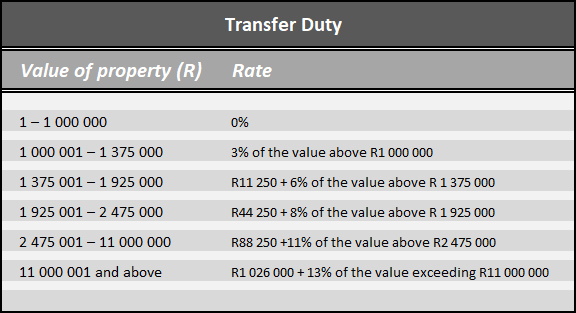
  • Transfer duty: Unless there’s VAT on the sale, the sale agreement will almost certainly also require you to pay the transfer duty, which is a government tax on property sales. No duty is payable on a property valued up to R1m and a sliding scale applies to houses above that threshold as per the table below –
Transfer Duty is payable at the following rates on transactions which are not subject to VAT: Acquisition of property by all persons:
Source : National Treasury
  • Moving costs: This step is easily overlooked, but your total moving costs can turn out to be much higher than expected when you include all the “hidden” expenses like redecorating, furnishing, new internet connections and so on.
  • Keep a contingency fund: It always seems to happen – no matter how carefully you plan your expenses, something unforeseen pops up. Or things cost more than you budgeted for. Or there’s a “black swan” emergency. Check that you have some ready cash to deal with these speedbumps.
Step 2: House hunting!
You know your price range, so on now to the really exciting part of all this – finding your dream house. Here’s a checklist to get you started –
  • Location, location, location: What area/s will you concentrate on? Where do you want to live? What sort of lifestyle are you after? Do you plan to work from home? Do you need to find a pet-friendly area? What amenities do you want close by? Are there good schools in the vicinity? Research the area – what are average selling prices in the suburb and is your budget up to it? Do houses in the area have a history of good value growth? What are crime levels like?
  • What sort of house are you looking for? How many rooms do you need? Will your needs change in the future? Do you need a home office? A granny flat? A big garden? A pool? The list of questions to ask yourself here is endless, just be sure to think of the long term as well as of your immediate wants and needs. And do bear in mind that sooner or later you will want to re-sell, so think now about whether the features you are looking for now will also appeal to other buyers down the line.
  • Searching: With your price range and target area identified, the “thrill of the hunt” is at last upon you! Online searches are increasingly popular but choose whichever channel you are comfortable with. Your lawyer will have valuable knowledge of the local housing market and may refer you to a trusted estate agency or two.
  • If buying into a community scheme: Check what Rules and Regulations you are letting yourself in for – you will be held to them. Make sure that the Homeowners Association or Body Corporate’s finances are sound (ask for audited financials and management accounts). Ask about any special levies or other planned expenditure on the horizon (get it in writing). Take professional advice in any doubt.
  • Plans, defects and the rest: Although the new Property Practitioner’s Act requires the seller to make disclosure of any defects or deficiencies (in a written document annexed to the sale document – study it carefully!), it is still advisable to do your own homework. Ask for copies of approved building plans (check for any unlawful structures or deviations from plan), look for and ask about defects like leaking roofs, problem foundations etc – consider getting a full professional report unless you are very sure of your own abilities in this regard.
Step 3: Putting in your offer
  • Now that you’ve found your dream house it’s time to put your offer in. Excitement mounts – will the seller accept, or perhaps counter-offer? You can’t wait to find out. You are presented with an Offer to Purchase (sometimes titled as a Deed of Sale), a pen and a cheerful “just sign here, we’ll do the rest”.
  • Take no chances here! Have the paperwork professionally checked before you commit to anything. Ask also for Deeds Office and other searches for anything that may affect your decision-making – restrictive title deed conditions, servitudes (giving other people rights over your property), alterations carried out without municipal plans and approval, zoning conditions and so on.
  • Make sure that any verbal undertakings or disclosures given to you are properly recorded in the agreement – what counts is what’s in writing!
Disclaimer: The information provided herein should not be used or relied on as professional advice. No liability can be accepted for any errors or omissions nor for any loss or damage arising from reliance upon any information herein. Always contact your professional adviser for specific and detailed advice.

© LawDotNews