Category

Family Law

Buying a Property: Check the Seller’s Marital Status!

By | Family Law, Property

“…a third party is expected to do more than rely upon a bold assurance by another party regarding his or her marital status” (quoted in judgment below)

If you are taking advantage of our current low interest rates and reduced selling prices to buy a property, make sure that you establish the seller’s marital status with something more than what the seller tells you.

Your risk comes in if the seller is married in community of property. That’s because, whilst our law generally allows spouses in such a marriage to “perform any juristic act with regard to the joint estate without the consent of the other spouse”, there are exceptions.

And one exception relates to immovable property. A spouse needs the written consent of the other to sell, mortgage or burden the property (by granting a servitude over it for example). Without that written consent the transaction is void, unlawful and unenforceable.

Which is where the danger comes in. Consider this scenario – you pay for and take transfer of a property from a seller who you think is unmarried, but a spouse suddenly appears and says “I never consented to that sale so it’s void. The transfer to you is cancelled so out you go and good luck getting your money back”. What now? 

Competing rights and a balancing act

There is of course a fine balancing act for courts involved here – on the one hand, the rights of the non-consenting spouse and on the other hand your rights as a good-faith buyer from a seller who you believed to be unmarried.  

A recent Supreme Court of Appeal (SCA) judgment addressed exactly that situation.

“But I thought I was buying from an unmarried seller”
  • A husband married in community of property sold and transferred a house to a buyer in 2009. At the time, his wife was not living in the house, having moved to another part of the country due to old age.
  • When the seller passed away in 2013 his wife was appointed executrix of his deceased estate. Some four years later she successfully applied to the High Court for cancellation of the deed of transfer on the basis that the sale had been without her knowledge or consent.
  • The buyer appealed to the SCA on the basis that the wife’s consent to the sale should be “deemed” to have been given in that the relevant legislation provides for such deemed consent where a buyer “does not know and cannot reasonably know that the transaction is being entered into contrary to [the requirement for written consent]”. 
  • He had, said the buyer, acted bona fide (in good faith) as he had not known of the marriage: “At the time I purchased the property from the deceased/seller, he was staying alone in the said property and he also confirmed to me that he was not married. He signed the deed of sale and also the transfer documents alone as unmarried.”
What the buyer must prove

The buyer had to prove that he did not know, and could not reasonably have known, that consent was needed but lacking. 

What the Court here needed to decide was whether the buyer should at the time of the sale have known of the marriage and the lack of written consent. “A duty is cast on a party seeking to rely on the deemed consent provision” held the Court “… to make the enquiries that a reasonable person would make in the circumstances as to whether the other contracting party is married, if so, in terms of which marriage regime, whether the consent of the non-contracting spouse is required and, if so, whether it has been given.”

Finding that the buyer had indeed proved (1) that he did not know that the deceased was married and (2) that he could not reasonably have known this, the SCA allowed the appeal and the transfer to the buyer stands on the basis of deemed consent by the spouse. 

The facts of each case will be different, and it is important to bear in mind that in this particular matter the husband’s claim to be unmarried was supported not only by the absence of any sign of a wife but also by two official documents – the deed of transfer and the power of attorney to pass transfer.

The bottom line is that as buyer you must make “reasonable enquiries” as to the seller’s marital status and as to whether the other spouse’s written consent to the sale is needed.

Disclaimer: The information provided herein should not be used or relied on as professional advice. No liability can be accepted for any errors or omissions nor for any loss or damage arising from reliance upon any information herein. Always contact your professional adviser for specific and detailed advice.

© LawDotNews

Life Partners – You Still Need a Will and a Cohabitation Agreement!

By | Family Law, Wills and Estate Planning


A recent High Court decision has been widely viewed as an important victory for the rights of unmarried opposite-sex life partners. Until now, if one such partner died intestate (without making a will), the other could not inherit on the same basis as could a married spouse. Nor could the surviving life partner claim maintenance from the deceased estate (whilst a surviving spouse can claim).

The High Court’s pronouncement that the relevant legislation was unconstitutional and invalid in this regard must still be confirmed by the Constitutional Court, but it certainly is a clear indication that our courts want to see our laws amended to protect the rights of such couples.

The life partner who will now inherit
  • An unmarried 57-year-old man died leaving substantial assets. Both the executor of his deceased estate and the Master of the High Court rejected, primarily on the basis of existing law, his surviving (female) partner’s claim to inherit from the estate.
  • She approached the High Court with her claim, and the Court found on the facts that the couple had been “partners in a permanent opposite-sex life partnership, with the same or similar characteristics as a marriage, in which they had undertaken reciprocal duties of support”. 
  • The provisions of the Intestate Succession Act and the Maintenance of Surviving Spouses Act were, held the Court, unconstitutional to the extent that they excluded opposite-sex permanent life partners from their provisions.
  • The practical effect is that the surviving partner will inherit as though she was a spouse.

But, if you are in an opposite-sex life partnership –

1) You should still make a will     

There’s no guarantee that the Constitutional Court will confirm the declaration of invalidity, but more importantly there are very sound reasons for everyone – married or not – to leave behind a valid and properly-drafted will.   

It is quite possibly the most important document you will ever sign. Without a will, you lose your right to choose who inherits what (your spouse for example will get only a “child’s share” on intestacy), you have no say in who will be appointed as the executor of your deceased estate, and you risk exposing your surviving loved ones to the trauma and expense of family dispute and litigation.

In the context of life partners, perhaps you want your surviving partner to inherit everything, or perhaps you don’t. The only way to ensure your desired outcome is to specifically provide for it in your will.

2) You should still have a cohabitation agreement

 An enduring myth in our society is that our law recognises the concept of a “common law marriage”. There is no such thing in South African law and whilst there are some limited statutory protections for life partners, if and when you part ways you could well find yourselves embroiled in a prolonged and bitter dispute. Quite possibly one of you will be left destitute after many years of “living as man and wife”.   

The quick and easy solution is to enter into a cohabitation agreement, it’s the best way to safeguard both of your rights (personal as well as financial). 

Disclaimer: The information provided herein should not be used or relied on as professional advice. No liability can be accepted for any errors or omissions nor for any loss or damage arising from reliance upon any information herein. Always contact your professional adviser for specific and detailed advice.

© LawDotNews

Grandparents – When Must You Pay Maintenance?

By | Family Law

“An inability on the part of the parents to maintain a child must be established before a grandparent will be legally liable to do so” (extract from judgment below)

One wonders how many grandparents are aware of (let alone plan for) the possibility that they may have a legal duty to support their grandchildren in certain circumstances.

It could be a heavy blow – trying to navigate one’s retirement financially can be hard enough without suddenly having to maintain not only yourself and your spouse but also a grandchild, possibly for decades. And what about the risk that when you die your deceased estate might remain liable – a drain, possibly a critical one, on your estate’s sufficiency to support your surviving spouse?

A recent Supreme Court of Appeal (SCA) decision confirms that –

  • As a grandparent you are potentially liable for maintenance during your lifetime but
  • When you die, your deceased estate will (as the law currently stands) not be liable. 
The adult granddaughter’s claim and the law

This was a damages claim against the executors of a grandfather’s deceased estate based on the proposition that the estate was liable to pay maintenance for a 30-year-old granddaughter unable to support herself because of psychiatric issues, mild intellectual disability and an autism spectrum disorder. The father had emigrated, had paid no maintenance, and was allegedly untraceable, whilst the mother’s ability or inability to fully support her child had not been established.

The SCA was asked to break new legal ground by extending a grandparent’s liability to his or her deceased estate, but on the evidence before it in this case (i.e. our courts may revisit this issue in the future) the Court declined to extend the law in this way, and set out our current law as follows –

  • Liability for maintenance generally depends on three factors –
    • The claimant’s inability to support him or herself.
    • His or her relationship with the person from whom support is claimed. 
    • That person’s ability to provide support.
  • The primary caregivers are the parents who have a duty of support as far as they are able to do so (this applies also to the parents’ deceased estates when they die). 
  • Parents and children have a reciprocal duty of support.
  • “If parents are unable to support their children who are in need of support, other relatives including grandparents, may be obliged to support them … But that duty is imposed first upon a nearer relative before it moves to remoter ones.” (Emphasis supplied).
  • However, as our law stands, a grandparent’s deceased estate is not liable.
In summary – 3 factors for liability

In other words, you (but currently not your deceased estate) could be liable to pay maintenance if –

  1. Your grandchild is not self-supporting, 
  2. Neither parent (nor their deceased estates) is financially able to provide the necessary support, and 
  3. You are financially able to do so.

Disclaimer: The information provided herein should not be used or relied on as professional advice. No liability can be accepted for any errors or omissions nor for any loss or damage arising from reliance upon any information herein. Always contact your professional adviser for specific and detailed advice.

© LawDotNews

© LawDotNews

Collecting Maintenance in Hard Times – Threaten Jail Time

By | Family Law

“Compliance with court orders is always important. There is a particular scourge in this country of spouses, particularly husbands, failing to pay judicially ordered maintenance” (extract from second judgment below)

Getting money out of serial maintenance defaulters is a notoriously difficult exercise, but even the most recalcitrant and cunning dodger will baulk at the prospect of being locked up for contempt of court.

And our courts, mindful of their position as “upper guardian” to all children, have shown again and again that they will have no hesitation in acting firmly against the sort of bad-faith defaulters we are talking about.

What must you prove?

You must prove not only a deliberate breach of the court order, but also that the breach was “wilful” and in bad faith. Although normally in non-criminal matters the standard of proof required is “on a balance of probabilities”, in contempt proceedings you have to prove bad faith on the much higher standard required for criminal convictions i.e. “beyond reasonable doubt”. 

As the Court in the second case below put it: “If, on a conspectus of all the evidence, it is a reasonable possibility that the husband’s non-compliance was not wilful and mala fide, he cannot be subjected to criminal sanctions for contempt.”

Of course, genuine inability to pay, which is no doubt more common now than it was before the COVID-19 lockdown, is a different matter altogether. We are talking here about dodgers who are able to pay but refuse to do so. A defaulter who simply cannot pay should apply for a variation of the court order. If the order stands, payment must be made – end of story.

Two recent High Court decisions illustrate –

First case: A “brazen” defaulter’s choice – pay or go to jail 
  • A father had been ordered, per a 2017 divorce settlement agreement, to pay R15,000 p.m. maintenance for his two minor children. He stopped paying in early 2018 and by the time this matter reached court he had run up arrears of R537,499. 
  • In response to the mother’s application to have him jailed for contempt of court, the father pleaded poverty – a standard ploy.
  • The Court was having none of that, and the mother had no difficulty in proving her case for contempt. 
  • Pointing out that the father was earning R147,000 p.m. (R83,000 net plus R10,000 to a provident fund), that he was paying R11,000 p.m. for a BMW and R14,000 p.m. on online gambling and trading, and commenting that “father’s position is extraordinarily brazen” the Court declared him to be in contempt of court. 
  • To avoid 30 days behind bars he must pay off the arrears in instalments in addition to keeping up his monthly maintenance payments. He also has to pay all legal costs on the punitive “attorney and client” scale.
Second case: Sorry, dogs, it’s not quite the same for you

Although our courts naturally take a dim view of anyone disregarding any form of court order, jail time is not the only possible sanction. Thus, in another recent High Court case a fine (R20,000 conditionally suspended for three years) was imposed rather than a prison sentence.

  • An acrimonious divorce action found a husband ordered to pay his wife on an interim basis for a variety of household expenses, including (the aspect that has captured most attention in the media) expenses relating to the couple’s two dogs for dog food, a dog walker, and veterinary, medical, and pharmaceutical expenses.
  • The husband claimed a genuine misunderstanding of his obligations under the court order (not least regarding his various obligations vis-à-vis the dogs), a defence accepted by the Court in some regards but not in others.
  • He also claimed inability to pay as a result of the lockdown’s effect on his company and his resultant reduction in salary – a defence rejected by the Court on the basis that he had “failed to put up evidence which should have been available to him to support a claim of unaffordability”. Similarly, his counter-application to reduce the amount of cash maintenance payable failed.

As to why the defaulter in this case avoided a prison sentence (as requested by his wife) the Court concluded that “imprisonment is not called for. I am dealing with a first infraction, which is considerably narrower than what the wife alleged.” One wonders whether another factor in that outcome might have been the fact that no children were involved, just a wife seemingly “unattractively intent on extracting more than her ‘pound of flesh’” and two pampered pooches. Certainly, the wife’s failures led the Court to award the wife only 75% of her costs, and on the ordinary cost scale rather than on a punitive scale.

Disclaimer: The information provided herein should not be used or relied on as professional advice. No liability can be accepted for any errors or omissions nor for any loss or damage arising from reliance upon any information herein. Always contact your professional adviser for specific and detailed advice.

© LawDotNews

Friends and Lovers: Before You Lend Out Your Car…

By | Contract, Family Law, General Interest

“Neither a borrower nor a lender be” (Shakespeare)

This is a case of a “love relationship” gone wrong but the principles of vehicle ownership apply to any situation in which you lend a motor vehicle to anyone else.

A widely-held misconception is that if you are the registered owner of a car, it is yours and you are the owner. Not so, as a recent High Court judgment aptly illustrates –

The registered owner unable to reclaim “her” car 
  • In what must at the time have seemed like a straightforward agreement between two people “in a love relationship”, a woman agreed to lend her lover a vehicle which she bought from a finance company under a loan agreement.
  • They had agreed verbally that he could use the vehicle for his personal use and would repay her for loan instalments, insurance, licencing, servicing, traffic fines and the like.
  • When the relationship soured, the woman asked the Court for an order returning the vehicle to her as owner. 
  • Although there was no dispute that she was indeed registered as owner of the vehicle, the Court dismissed her application on the basis that, whilst possession of a vehicle’s registration papers is prima facie (“at first view”) proof of ownership, it is never conclusive proof of ownership. Nor is any change of ownership required to be registered for transfer to take place. So in this case the registration papers did not prove ownership, the actual owner being the finance company.
  • This is different to the position with land, where registration of ownership in the Deeds Office proves ownership and is necessary for transfer of ownership. That no doubt is the origin of the myth that being registered as the owner of a car proves that you are the owner – an incorrect and dangerous assumption.
  • The woman was accordingly not the owner of the vehicle, rather the finance house was the owner in terms of the lease agreement which provided that it retained ownership until all amounts due under the agreement had been paid in full.
  • End result – the ex-lover keeps the car, for now at least.
Lessons for lending out cars…
  • Should you decide to lend out your car, make sure to do it under a written agreement – the parties in this case were lucky that they could agree on the terms of their verbal agreement as our law reports are replete with bitter and expensive litigation over what everyone said and who agreed to what verbally.
  • Include a term spelling out clearly your rights to recover possession of the vehicle. The woman in this case would have been in a far stronger position if the parties had agreed that, even if the man held up his end of the bargain to pay for all the loan instalments and other expenses, the woman still retained the right to reclaim the vehicle if their relationship ended (she still wouldn’t have sued as owner, just to enforce the agreement). 
  • For life partners and cohabiting couples this is yet another reminder that there is no such thing as a “common law marriage” in our law. There are no automatic marital or other rights attaching to your relationship and applicable when the relationship ends, so entering into a full cohabitation agreement is the only way to safeguard both your and your partner’s financial and personal rights.

Disclaimer: The information provided herein should not be used or relied on as professional advice. No liability can be accepted for any errors or omissions nor for any loss or damage arising from reliance upon any information herein. Always contact your professional adviser for specific and detailed advice.

© LawDotNews

Domestic Violence and the Lockdown: Your Personalised Safety Plan

By | Family Law

“Preamble to the Domestic Violence Act: “To afford the victims of domestic violence the maximum protection from domestic abuse that the law can provide”

There is great concern that the COVID-19 crisis, particularly the mandatory “stay at home” lockdown phase, will see both an increase in the levels of domestic violence, and a decrease in the ability of victims to access help. It’s a worldwide concern and as the World Health Organisation puts it: “Stress, the disruption of social and protective networks, loss of income and decreased access to services all can exacerbate the risk of violence for women.”

South Africa’s Domestic Violence Act (“domestic violence” isn’t limited to cases of physical harm – it includes a very wide range of abusive conduct) provides legal protection to victims, especially to those most vulnerable such as women, children, disabled people and the elderly.   If you are a victim (or helping a victim) you should be aware of a victim’s rights to lay criminal charges and/or to apply for a protection order.  

Police officers attending to such cases must help victims to lay criminal charges, find shelter and obtain medical treatment where necessary. The Supreme Court of Appeal has confirmed that SAPS members have a positive duty to render assistance to victims.

But how can you achieve that with the lockdown restrictions and its constraints on your freedom of movement and ability to escape the abuser?

Your personalised safety plan

Note that from 14 May 2020 new lockdown regulations specifically allow you to move to a new home where “the movement is necessitated due to domestic violence”. 

Download here the National Shelter Movement of South Africa’s free PDF document “Domestic Violence Safety Planning During the Time of COVID-19” which will help you with suggestions for developing a personalised and practical Safety Plan during lockdown under these headings –

  • “Be Prepared” with a comprehensive list of helplines and contacts (both National and Provincial) and how to access them
  • “Reaching Out”
  • “Signalling for Help”
  • “Delete Searches/Requests for Help”
  • “Planning to Leave”
  • “Legally Speaking”
  • “Leaving”
  • “Staying Safe”.
How a protection order works

The “Staying Safe” section above suggests that you apply for a protection order if you don’t already have one, and that you get help in doing so from a shelter or other organisation. Or you can yourself approach your nearest Magistrates Court and ask for assistance.  

If an order is granted, the issue of a warrant of arrest is authorised at the same time.  The warrant is suspended on condition that there is no breach of the terms of the protection order.  To have the warrant executed, you will need to give details of any violation of the order on affidavit – be aware that you will both face criminal charges and risk a damages claim if you intentionally make any false allegations.  

Disclaimer: The information provided herein should not be used or relied on as professional advice. No liability can be accepted for any errors or omissions nor for any loss or damage arising from reliance upon any information herein. Always contact your professional adviser for specific and detailed advice.

© LawDotNews

Divorce in a Time of Lockdown – What Grounds Can You Rely On?

By | Family Law

Note: If, as we hope, you personally have no need for an article on divorce, please think of passing this on to anyone you know who may find it relevant and useful.

The National Lockdown has thrown together many couples not used to spending “24/7” time in each other’s company. Relationships will have strengthened for many couples, but others will be struggling. The fears, anxieties and money worries now looming over us all certainly won’t haven’t helped. 

If your marriage is one of those unfortunate ones that is foundering, counselling hasn’t helped or won’t help, and you have come to the decision that divorce is your only option, be aware that you need a formal court order before your divorce will be legally recognised.

Moreover our law does not recognise the concept of “legal/judicial separation” so if you decide to just physically separate without divorcing, you should take professional advice on drawing up a contract in the form of a “separation agreement”. Normally this would be for a trial period but you could also agree to a longer-term separation. 

The 3 grounds for divorce

In most cases couples opt for formal divorce rather than long-term separation, and it is important to appreciate that a court will only grant a divorce order if it is satisfied that at least one of the three recognised grounds for divorce exists. 

In practice most couples will fall under the first ground i.e. “irretrievable breakdown of marriage” but to give you the full picture, the grounds for divorce in full are (all quotes are straight from the Divorce Act) –

  1. Irretrievable breakdown of marriage

    This is by far the most commonly relied on ground for divorce: “A court may grant a decree of divorce on the ground of the irretrievable breakdown of a marriage if it is satisfied that the marriage relationship between the parties to the marriage has reached such a state of disintegration that there is no reasonable prospect of the restoration of a normal marriage relationship between them.” 

    The court may take into account “any facts or circumstances which may be indicative of the irretrievable breakdown of a marriage” and may also accept evidence that –
    1. The spouses have not lived together for “a continuous period of at least one year immediately prior to the date of the institution of the divorce action”; 
    2. The spouse being sued for divorce has committed adultery and the other spouse “finds it irreconcilable with a continued marriage relationship”; or  
    3. The spouse being sued for divorce “has in terms of a sentence of a court been declared an habitual criminal and is undergoing imprisonment as a result of such sentence”.
      However: “If it appears to the court that there is a reasonable possibility that the parties may become reconciled through marriage counsel, treatment or reflection, the court may postpone the proceedings in order that the parties may attempt a reconciliation.”
  2. Mental illness    

    The court must be satisfied of two things here –   
    1. The spouse must have been admitted to or detained in an institution under our mental health legislation as a patient, State patient or mentally ill convicted prisoner, and “has, for a continuous period of at least two years immediately prior to the institution of the divorce action, not been discharged unconditionally”, and 
    2. After having heard the evidence of at least two psychiatrists, of whom one shall have been appointed by the court, that the defendant is mentally ill and that there is no reasonable prospect that he will be cured of his mental illness.”
  1. A state of continuous unconsciousness “by reason of a physical disorder”

    Again the court must be satisfied of two things here –
    1. The unconsciousness must have lasted “for a continuous period of at least six months immediately prior to the institution of the divorce action”, and
    2. After having heard the evidence of at least two medical practitioners, of whom one shall be a neurologist or a neurosurgeon appointed by the court, that there is no reasonable prospect that the defendant will regain consciousness.
Having grounds for divorce is not the end of the story

You will need also to satisfy the court that “the provisions made or contemplated with regard to the welfare of any minor or dependent child of the marriage are satisfactory or are the best that can be effected in the circumstances”.

Consider also, and prepare for, questions around division of assets and maintenance.

Disclaimer: The information provided herein should not be used or relied on as professional advice. No liability can be accepted for any errors or omissions nor for any loss or damage arising from reliance upon any information herein. Always contact your professional adviser for specific and detailed advice.

© LawDotNews

Beware the “Common Law Marriage” Myth

By | Family Law

“In our law cohabitation does not have special legal consequences. Generally the proprietary consequences and rights flowing from a marriage are not available to unmarried couples, regardless of the length of their cohabitation” (extract from judgment below)

If you live as a couple, avoid the trap of believing the myth of the “common law marriage”. It’s a very persistent myth, possibly because some other countries do indeed give formal recognition to certain forms of life partnership.

But not in South Africa – there is no such thing in our law as a “common law marriage”.  No matter how long you have lived together, if you break up or when one of you dies, neither of you automatically has any of the rights and protections afforded to a couple in a marriage or civil union. 

Apart from the personal consequences the financial downsides can be huge, and our courts are all too often faced with sad and bitter disputes which end with one of the partners destitute and homeless after decades of cohabitation.

A recent High Court case highlights the financial dangers…

22 years on, a couple splits
  • For most of 22 years, with only a short early separation, a man and woman “in a romantic relationship” lived as a couple, in a household complete with the woman’s daughter from a previous relationship.
  • They had been jointly involved to one degree or another in a series of business ventures including vegetable farming (on a farm purchased in the man’s name), commercial blasting, a bakery and a packaging business, and what was at stake in the High Court was whether the woman could prove her claim to a 50% share of the resultant assets.
  • The facts were bitterly disputed, with the man adamant that the relationship had been nothing more than co-habitation as lovers. But eventually the Court concluded, on the basis of the facts that it found proved, that “the parties intended to pool their resources for the benefit of a joint estate” and that the woman had accordingly proved the existence of a “universal partnership”.
  • Not however to the 50/50 extent she claimed, and the end result is that at age of 47 and after 22 years she leaves the relationship with only 30% of the net assets. Hard though that may seem, she could easily have been left with nothing, as we shall see below when we look at what our law says about such relationships.
The difficulty of proving a “universal partnership”

The problem in such a case is that you have to prove a lot more than just cohabitation. 

You also need to prove the existence of a “universal partnership” and that, as many cases in the past have illustrated, is not easily achieved, not least because the onus is on you to prove your case. You will need to prove all of the following – 

  1. Each of the parties brought something into the partnership, or bound themselves to bring something into it, whether it be money or labour skills;
  2. The business had been carried on for the joint benefit of both parties;
  3. The object was to make a profit; and
  4. The partnership contract was legitimate.

If, as is common in this sort of situation, you rely on a “tacit” agreement (an unexpressed agreement inferred from your actions as a couple), you have to go further and prove that –

  1. The other person was fully aware of the circumstances connected to the transaction;
  2. The act relied upon was unequivocal; and 
  3. The tacit contract does not extend beyond what the parties contemplated.

Again, not easily proved, as “A tacit contract will be interpreted strictly and not extensively, since a contract must be interpreted in favour of the person on whom it is sought to place an obligation.”

The good news – there’s a simple solution…

We have talked above only about the financial consequences of life partnerships which are unregulated by agreement. But formal marriage also provides a range of other legal benefits and protections (such as rights of inheritance and support and other personal aspects of your relationship) which are not automatically available to you.

Fortunately you can avoid all the risk and uncertainty of an unregulated relationship with a quick and simple solution – a formal cohabitation/life partnership agreement. 

Just be sure to get it in place early on. Take professional advice (jointly – this is to protect you both!) as soon as you commit to a long-term relationship.

Disclaimer: The information provided herein should not be used or relied on as professional advice. No liability can be accepted for any errors or omissions nor for any loss or damage arising from reliance upon any information herein. Always contact your professional adviser for specific and detailed advice.

© LawDotNews

January is “Divorce Month”: Beware the Dangers of DIY

By | Family Law

January is “Divorce Month”: Beware the Dangers of DIY

“What’s the only thing divorce proves? Whose mother was right in the first place” (Anon)

The festivities are over, the bills are coming in and everyone is returning to reality. Couples who for most of the year only have to live with each other after work hours, have suddenly spent a whole lot more 24/7 time in each other’s close company. Little irritations have magnified, habits have got on each other’s nerves, in-laws visiting for the annual family bun fight have heightened tensions…

Whatever the reasons, and whether only one party was at fault or both, January’s worldwide reputation as “divorce month” applies equally here in South Africa. Which means that the legal and personal risks associated with divorce are peaking now, in January.

On the legal side of things a particular risk to be aware of is the temptation for couples splitting on an “uncontested” (i.e. by mutual agreement) basis to opt for a “DIY” divorce. 

Beware, that’s a siren’s call…

The dangers of a DIY divorce

Divorce is full of both legal and practical pitfalls, and any mistakes a divorcing couple makes now could well live with them, their children, and their extended families for life.

The hard fact is that whilst DIY divorce may seem affordable and workable, specific legal assistance and guidance is worth every cent it costs – and particularly in uncontested matters the cost of proper legal help certainly won’t break the bank. Without such advice, the average couple risks the exact opposite of “affordable” in the form of a great deal more expense (not to mention stress and heartache) than had they consulted an attorney upfront.

To illustrate some of the many relevant issues the couple must take into account –

  1. Formalities: Getting divorced means complying with a list of formalities and requirements, and appearance in either the High Court or the Divorce Court. Getting anything wrong here is a recipe for disaster.
  2. Consent paper: A settlement agreement (often called a “deed of settlement” or “consent paper”), setting out what the couple has agreed to regarding children, maintenance, division of assets etc, should be made an order of court to give it the status of an enforceable judgment. The agreement should cover everything important, clearly and unambiguously – overlooking something vital (easy for the layperson to do) will come back to haunt everyone.
  3. Children: The most vulnerable parties in any familial breakup, children enjoy special protections in our law, and parents need to take into account questions of parental responsibilities and rights including “care and contact” (the new terms for “custody and access”), guardianship, maintenance, formal “parenting plans”, health care and the like.
  4. Maintenance: In addition to child maintenance, one spouse may have a claim on the other for spousal maintenance, either on an interim basis or longer-term.
  5. Financial implications and division of assets: Particularly where valuable assets are involved (a house or other property perhaps, or rights to a pension fund) the divorcing couple should agree on a split, on how property transfers will work, who will pay for what, who will assume financial obligations like home bonds etc. Which “marital regime” the couple was married under becomes important here, as does the question of whether or not there is an ANC (ante-nuptial contract) in place. A whole host of other legal and practical issues are also at stake. 
A final thought on controlling costs…

If you have a particular need to control costs, be open with your attorney and ask for advice on whether you can minimise them in any way.

Disclaimer: The information provided herein should not be used or relied on as professional advice. No liability can be accepted for any errors or omissions nor for any loss or damage arising from reliance upon any information herein. Always contact your professional adviser for specific and detailed advice.

© LawDotNews

Visiting South Africa with Kids Just Became Easier – Here’s What You Need to Know

By | Family Law, General Interest

“We’re all going on a summer holiday…” (Cliff Richard)

With the Festive Season (and our Summer Holidays!) well and truly upon us, you may be inviting family or friends to visit you from overseas with their children, or perhaps you are a foreigner planning a family trip to South Africa. Either way here’s some good news in the form of a welcome concession from government in regard to the documentation you will need to produce on entry. 

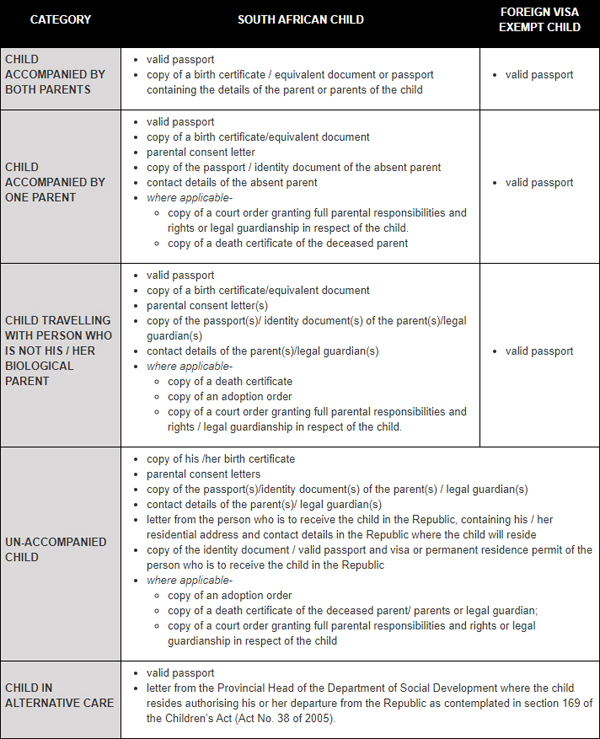
In a nutshell foreign children until now have only been able to enter the country with unabridged birth certificates and consent letters. That requirement was waived – for accompanied children only (check the full details in the table below) – from 8 November 2019. 

The Department of Home Affairs (DHA) says it has communicated this very welcome new development to all role players, most importantly to the immigration officials at ports of entry who are tasked with enforcing the rules, but if you do happen to have documentation handy it can’t hurt to bring it along in case of any queries. If you need visas to visit you will anyway have to produce the documents when applying.

South African children (and unaccompanied foreign children) must still provide a list of required supporting documents – see below.

Note that the above is just a summary – it is extremely important that you check the DHA table below for full details, and that you ask your lawyer for help if you think any exemptions may apply, if you have any difficulty in understanding what is required, or if you cannot get the necessary documentation together.

DOCUMENTS REQUIRED FOR CHILDREN TRAVELLING THROUGH A PORT OF ENTRY OF THE REPUBLIC

(Source – Department of Home Affairs)