Category

Family Law

Love and the Law: Cohabiting? Get Your House in Order Now

By | Family Law, Property

“All you need is love… and a good lawyer.” (Anonymous)

February, with its Valentine’s Day chocolates, roses and declarations of undying love, should be a month for romance, not legal niceties. But in the real world, love and the law are inextricably linked because any relationship’s structure and consequences are inevitably governed by legal principles. Losing sight of that can expose you to unnecessary angst, dispute, and litigation.

A recent High Court fight between an estranged couple over their jointly-purchased dream house illustrates this neatly.

Broken dreams, and a fall out over the house

A couple’s four-year romantic relationship saw them living together first in her mother’s house and then in his apartment. They then decided to buy a house together with the idea of making their relationship more permanent.

Unfortunately, that dream came to nought – their relationship ended a month after the property purchase, leaving only one of them to live in the house and to pay all the ongoing costs while they decided what to do next.

In due course they fell out over how to end the co-ownership and how to adjust their respective claims for past and future property costs.

Their dispute reached the High Court, which ordered firstly that the co-ownership be terminated. This was necessary, because no co-owner can be forced against their will to remain a co-owner where the relationship between the co-owners has deteriorated to such an extent that it can’t continue.

Then, using an old Roman law remedy still in use today (the “actio communi dividundo”) the Court dealt with both the division of the property, and the adjustment of the various financial claims between the parties. As is usually the case, these were complex and intertwined after years of cohabitation.

Importantly, the Court noted a modern move away from the traditional principle that the property should necessarily be sold by public auction to the highest bidder, towards a much more flexible approach based on the Court having a wide discretion to ensure a fair and practical outcome in each case.

Thus, having considered all the circumstances, wishes and claims of both parties, the Court ordered that the ex-partner living in the house has a first option (valid for 60 days) to buy the other’s half share at valuation. If he doesn’t, he must offer it for sale on the open market at a fair and reasonable market-related price. If there’s still been no sale after 6 months, the Sheriff of the High Court becomes a “receiver and liquidator” and has 4 months to auction the house. The bond, costs and parties’ related financial claims will be settled from the proceeds as directed by the Court.

“Co-ownership is the mother of dispute” – But it needn’t be

“Co-ownership is the mother of dispute” (“communio est mater rixarum”) is another old Roman law concept mentioned by the Court. It confirms that joint ownership has always, since ancient times, inherently provided fertile ground for instability and dispute.

But that needn’t be so. An upfront agreement between joint owners, whether their arrangement is grounded in a commercial or a personal relationship, can hugely reduce the risks of later uncertainty, disagreement and litigation.

Put as much detail into your agreement as you can, including a detailed process of how to end your co-ownership if required. Litigation – with its delay, expense, and uncertain outcomes – should never be embarked on lightly. As the Court wryly quoted from a previous decision, “a court cannot perform miracles”. It will of course do its best to craft the fairest possible outcome for both parties, but avoiding the dispute altogether is always a better option for everyone involved.

P.S. Don’t forget your cohabitation agreement

As a final thought, if you are living with your life partner, you should have a full cohabitation agreement to cover not only your co-ownership arrangement, but also all the other financial and personal aspects of your relationship that would normally be governed by our marriage laws.

Disclaimer: The information provided herein should not be used or relied on as professional advice. No liability can be accepted for any errors or omissions nor for any loss or damage arising from reliance upon any information herein. Always contact us for specific and detailed advice.

© LawDotNews

How to Fund Your Divorce if Your Spouse Can Outlitigate You

By | Family Law

“For what is wedlock forced but a hell, An age of discord and continual strife?” (William Shakespeare in Henry VI Part I)

This article is a balm for anyone unfortunate enough to be stuck in an unhappy marriage full of Shakespeare’s “discord and continual strife”, yet too scared to consider divorce because of the costs. An uncontested divorce in which you agree on everything need not cost much, but it’s a very different story if you know that your spouse will fight you to the bitter end.

The hard reality is that contested divorces can be extremely expensive. But if your emotional trauma is compounded by the fact that your spouse has a lot more money than you and will use that financial strength to intimidate and outlitigate you, don’t despair!

Outgunned? “Equality of Arms” to the rescue

Enter stage left the “equality of arms” legal principle, which is aimed at ensuring that the outcome of divorce litigation is based on the merits of the case, not on one side’s financial dominance.

In other words, our law says that you should have a fair and reasonable ability to present your case without being disadvantaged because your spouse has greater financial resources. To achieve that, as the financially weaker spouse you can ask the court to order your spouse to contribute to your costs, allowing you to access proper legal advice, to negotiate fairly, to resist pressure to accept unfavourable settlement terms, and, if necessary, to proceed to trial.

What factors will the court consider?

The other side of the coin is that it’s not “open season” on your spouse’s wallet. The court will order only a contribution to costs that is reasonable and necessary considering all the factors relevant to each case, typically:

  • The financial resources of both parties
  • The level of complexity in the divorce case
  • The anticipated expenses for proper legal representation

Bottom line: you’re automatically entitled to a contribution. You must show that you are in genuine need given your own financial situation, that your estimated costs are reasonable in relation to the complexity of the disputes between you, and that your spouse can afford it.

A recent High Court decision provides an excellent example of those principles in action.

A wealthy husband is ordered to pay R1.5 million

The couple in question were married in 2010, out of community of property with the accrual system. They lived, it seems a “lavish lifestyle characterised by frequent overseas trips and a taste for opulence” until the husband left home in 2020. Battle commenced with the wife issuing a divorce summons a few months later.

Five years on we find them locked in dispute over the true extent of the husband’s wealth, with the wife applying for a R2 million costs contribution to cover both her legal expenses and a forensic investigation into her husband’s financial affairs.

In his Financial Disclosure Form (a standard form completed by parties to a divorce) he had listed net assets of R34 million. But the Court – finding that these disclosures were “unreliable”, that he had failed to disclose the value of his shareholdings in two companies and of a property in France, and that “there are huge sums of money not being disclosed” – decided that the wife’s proposed financial investigation was justified.

Having analysed the respective financial positions of the parties and their respective abilities to cover the costs in question, and having decided that the wife could reasonably trim some of her projected expenses, the Court ordered the husband to pay her a contribution of R1.5 million.

Don’t be intimidated by a big war chest

If you are outgunned financially, you may well be entitled to ask for a contribution to your divorce costs in order to level the playing field. Ask us whether you qualify.

Disclaimer: The information provided herein should not be used or relied on as professional advice. No liability can be accepted for any errors or omissions nor for any loss or damage arising from reliance upon any information herein. Always contact us for specific and detailed advice.

© LawDotNews

Wedding Bells? You Can Both Choose Your Own Surnames Now

By | Family Law

“A family name holds the music of generations – it’s the first inheritance we receive.” (Attributed to Irish poet-philosopher John O’Donohue)

The Constitutional Court has just confirmed (with some significant adjustments) last year’s High Court ruling that both partners in a marriage have equal rights to choose their surname.

Previously, a woman – and only a woman – could choose when marrying to take her spouse’s surname, or to retain her own surname, or to assume a double-barrelled surname (her own surname with her husband’s surname).

However, if a man wanted to do the same (to adopt his wife’s surname or a double-barrelled surname) he had to apply formally to the Department of Home Affairs (DHA) and provide “good and sufficient reason” for wanting to change. The problem with that is that the reason had to be related to “a change in the marital status of a woman” – an impossible ask for men.

A tale of two couples

The Constitutional Court, and the High Court before it, grappled with this issue via applications from two couples whose attempts to depart from the “only women can choose” rule had been thwarted by the existing wording of the Births and Deaths Registration Act.

The couples’ reasons for wanting to depart from the norm will ring a bell with many. One couple wanted their new family to bear the wife’s maiden name as it symbolized her connection to her parents, who had died when she was young. The other wanted both spouses to use a combined (double-barrelled) name so that the wife’s maiden name, which is important to her, was not lost.  

Our apex court has now confirmed that this unequal treatment was unconstitutional because it discriminated on the basis of gender, infringing on their rights to equality and dignity.

So, what are your choices now?

In a nutshell, the Court’s order employs gender-neutral language to ensure that everyone, regardless of gender or type of marriage, now has the same automatic rights when it comes to assuming a new surname.

Although the declaration of invalidity is suspended for 24 months to enable Parliament to either amend existing legislation or to pass new legislation, the Court’s ruling includes the provision that in the interim everyone can, as of right and without needing DHA authority:

  • After marriage, take their spouse’s surname or, having taken it, resume a previous surname.
  • After marriagedivorce or the death of a spouse, resume a previous surname or create a double-barrelled surname.

Any other surname changes (including changes to your children’s surnames) still require application to DHA.

To avoid any confusion, it’s a good idea to tell the marriage officer before you marry what names you’ve chosen so the correct choices appear in the marriage register and on your marriage certificate.

Give us a call if we can help with anything.

Disclaimer: The information provided herein should not be used or relied on as professional advice. No liability can be accepted for any errors or omissions nor for any loss or damage arising from reliance upon any information herein. Always contact us for specific and detailed advice.

© LawDotNews

Divorce Lawfare: The Serial Litigant and his Stalingrad Strategy

By | Family Law

“This [the Stalingrad Strategy] is a strategy of wearing down the plaintiff by tenaciously fighting anything the plaintiff presents by whatever means possible and appealing every ruling favourable to the plaintiff. Here, the defendant does not present a meritorious case. This tactic or strategy is named for the Russian city besieged by the Germans in World War II.” (Judges Matter website)

Divorce disputes are of course intensely personal and emotionally charged affairs — and when feelings run high the resultant fallout can mean protracted, bitter, and costly litigation. 

If you are being subjected to a barrage of such litigation, take heart. In balancing our constitutional right to access the courts against the need to prevent people from abusing court processes with endless and meritless litigation, our law provides for “vexatious litigants” to be stopped dead in their tracks. 

A recent pair of High Court decisions (featuring the same parties and the same divorce dispute, but in two different battles) provides a textbook example. 

A saga of litigation, complaints, threats, and blackmail

This 11-year saga dates from the start of divorce proceedings in 2014, with the financial aspects of the divorce being finalised only in 2020. The ex-wife was awarded a total of R16.8m in accrual, maintenance, and costs. The ex-husband’s property-owning trust was held to be his alter ego, and that opened the door for the house held by the trust (a valuable property in an upmarket Cape Town golf estate) to be sold as his asset.  

He responded with a concerted campaign of unrelenting litigation, complaints, and threats — all aimed, the Courts have now determined, at overturning the divorce order. 

The list of his serial litigation and intimidation tactics is both long and extraordinary, but suffice it to say that a flood of applications of all sorts to a wide variety of courts (all the way up to the Constitutional Court) is just the tip of the iceberg. He has also lodged professional complaints against all the attorneys and advocates involved in this matter (including his own legal team) and against the Divorce Court Judge. Not even his own financial expert escaped a formal complaint. Allegations of perjury, fraud and collusion abound. He has threatened massive lawsuits (for R210m and R190m to date) against various legal representatives. He was even found to have resorted to blackmail. 

Neither his singular failure to reap anything but defeat from any of these endeavours (barring a few minor skirmish successes, and noting that some of the more recent matters remain pending), nor the slew of costs orders made against him (at least one of them on the punitive attorney and client scale), seem to have deterred him in the slightest. 

His latest rearguard action, a failed attempt to postpone the auction sale of his house, has earned him yet another defeat and another costs order, with the cherry on top being his being declared a “vexatious litigant”. He can now no longer launch legal proceedings without specific High Court authority to do so. 

All’s fair in love and lawfare? Not so fast

As the Court put it: “A fundamental doctrine in our law is, there must be an end to litigation … nobody should be permitted to harass another with second litigation on the same subject as such litigation can be viewed as an abuse of process.” Our courts accordingly have the power to declare such a person a “vexatious litigant”, thus restricting them from launching any new legal proceedings without specific court authority. 

To have your opponent declared vexatious, you will need to prove that the person “has persistently and without any reasonable ground instituted legal proceedings in any court or in any inferior court, whether against the same person or against different persons.” There are two legs to that, and note that you can’t stop anyone from pursuing normal appeal and review processes — there must be some abuse of judicial process. 

You may also be able to get an order that your opponent provide security for your costs. Although, in this particular matter, the ex-wife was unable to convince the Court to grant her such an order. 

Disclaimer: The information provided herein should not be used or relied on as professional advice. No liability can be accepted for any errors or omissions nor for any loss or damage arising from reliance upon any information herein. Always contact us for specific and detailed advice.

© LawDotNews

Divorce 101: A Simple Guide to the Legal Side

By | Family Law

“You can’t go back and change the beginning, but you can start where you are and change the ending.” (C.S. Lewis)

Divorce is traumatic, to the extent that it’s widely considered to be the second most stressful life event (behind only the death of a spouse, and ahead of marital separation and going to jail!). 

But if you’ve come to the conclusion that your marriage is so unhappy or toxic that you have no alternative but to put an end to it, you’ll need to know how to go about obtaining a divorce, and what your legal rights are.

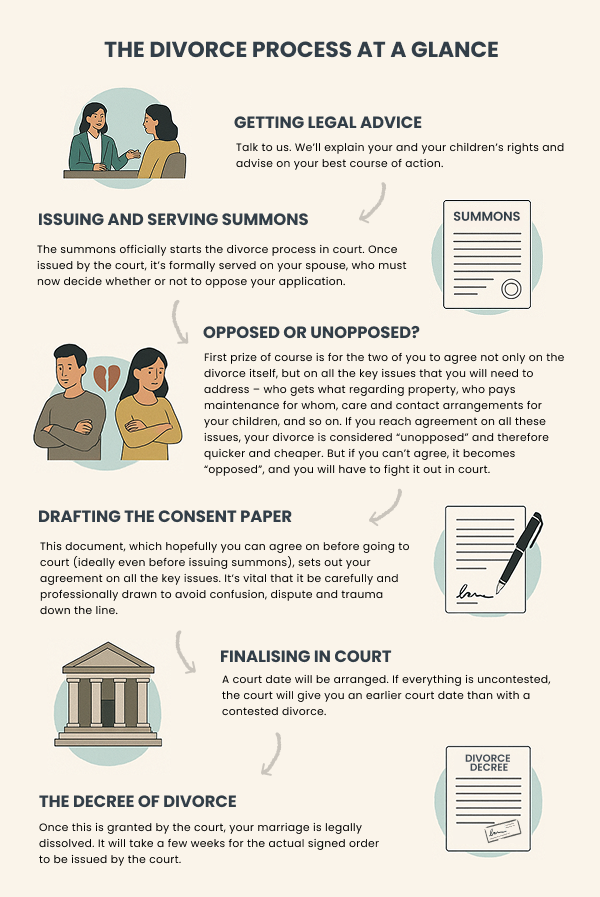
The whole process can feel overwhelming, but it needn’t be. Here’s a clear, simplified overview, followed by a Q & A section to address some of the concerns and queries you may be grappling with.

9 common questions answered

Here are some of the most commonly asked questions. Let us know if you have any others!

  1. Do I have grounds for divorce? Our law has since 1979 had a “no fault” concept, so all you must show is that your marriage has broken down irretrievably, with no reasonable possibility of reconciliation. Mental illness or coma are other grounds for divorce but fortunately they rarely apply.
  2. How long does it all take? In an uncontested divorce (depending on how quickly you reach agreement, how busy the courts are, and a myriad of other factors) you should work on between two and three months. A complex contested divorce on the other hand could take years, particularly when fought bitterly through all the appeal courts.
  3. How are our children protected? Parenting plans, care and contact, maintenance and schooling arrangements can and should be settled by agreement if possible. Otherwise, the Family Advocate’s office can help – it’s a free and impartial service, tasked with protecting the welfare of children through investigation, mediation, reporting and making recommendations to the court. If you are still deadlocked and leave it to the court to decide one way or the other, bear in mind that our courts always put your children’s best interests first – no exceptions.
  4. What about maintenance for me and our children? Both of you must contribute to the reasonable financial needs of your children based on your respective financial positions, and child maintenance orders in favour of the parent with primary care (“custody” in the old terminology) are commonly granted. Orders for spousal maintenance (“alimony” in American legalese) are less common and depend on a host of factors. You may also be able to claim interim maintenance pending the divorce.
  5. How much will this cost me? We can give you an idea of the likely cost based on whether or not the divorce is contested and the complexity of the issues involved. A simple, uncontested divorce will always be the least costly option. If the divorce is contested and you can’t afford to pay legal fees, you may be entitled to a contribution to your legal costs from your spouse. Sometimes, when granting a disputed divorce, a court will order one of you to pay the other’s costs, but the general rule is that each of you will pay your own costs. And of course you can always agree between yourselves who pays what costs. 
  6. What assets will I get? What you are legally entitled to depends largely on whether you are married in community of property or out of community of property (with or without accrual), and on what your ante-nuptial contract (if you made one) says. The court also has wide discretion to order a redistribution of assets in your favour in appropriate cases – and of course you can agree between the two of you to divide assets any way you want. 
  7. What if there’s domestic abuse? We’ll help you get an urgent protection order to keep you and your children safe. 
  8. I really don’t want this to go to trial, how can I avoid that? Mediation is often an effective way to help parties reach an agreement on contentious issues. The reality is that most divorce disputes are eventually settled by agreement – if not upfront, then “on the steps of the court”, or perhaps only after battle has begun and everyone can see which way the wind’s blowing. 
  9. How does Home Affairs know I’m divorced? We’ll help you send a certified copy of the divorce decree to Home Affairs to update your marital status on the National Population Register.

Talk to us if you’re considering divorce – or even if you just want to understand your options.

Disclaimer: The information provided herein should not be used or relied on as professional advice. No liability can be accepted for any errors or omissions nor for any loss or damage arising from reliance upon any information herein. Always contact us for specific and detailed advice.

© LawDotNews

Good News for Grandma: The Law Wants You to Have Access to Your Grandchildren

By | Family Law

“Grandparents, like heroes, are as necessary to a child’s growth as vitamins.” (Quoted in the judgment below)

One of the greatest tragedies of family fall-outs will always be the effect they have on the children involved. A recent High Court fight over a granny’s attempts to have contact with her two grandchildren in the face of bitter opposition from their father confirms that what really counts is what’s best for the grandchildren.

A tragic death, and a family fight

Two boys, aged 9 and 13, are the innocent subjects of this legal wrangle. They live with their father in Makhanda.

Their mother, a professional nurse serving in the SANDF with the rank of captain, tragically died in a motor accident three years ago.

Their father, currently a High Court advocate, had met their mother while a member of the SANDF’s Special Forces Unit. They were never formally married but the two children were born of their union. He is described as a good father providing his boys with good care and a stable home and family life.

Their grandmother is widowed and a retired nurse and midwife. Her requests to the father for contact with her grandchildren were met with an obstinate refusal to even engage with her. His intense dislike for her – based, he said, on his late partner’s anger issues with her –  was reiterated in his stance in the Children’s Court where he made it clear that he refused ever to talk to her.

The grandmother lives in the village of Herschel on a large plot, is in good physical and mental health, and says she is well able to look after for the children while in her care.

The Children’s Court, having received the reports and evidence of social workers (which spoke of a healthy relationship between mother and grandmother in contradiction to the father’s perception), granted access to the grandmother.  

The father appealed this order to the High Court. While accepting that the father genuinely believed that he was acting in his children’s best interests, the higher court upheld the contact order, albeit in a more structured form than the original. The grandmother now has access by way of:

  • Weekly telephonic/multimedia contact
  • Monthly day visits with her in Makhanda
  • Mid-year and year-end school holiday visits to her home in Herschel, for a week at a time, initially under the supervision of the Department of Social Development
The decisive consideration

The Children’s Act sets out in detail a wide variety of factors to be considered by a court in deciding any application for access (referred to as “contact” in the Act). But as the Court here pointed out, the decisive consideration is always going to be the best interests of the child.

Every case will be unique, but one highly relevant factor that our courts will have regard to is “the need for the child to remain in the care of the parent, family, and extended family and to maintain the connection with his family, extended family, culture and tradition”.

Let’s close with this particularly apt observation from the Court (emphasis supplied): “Usually, it is in the best interests of a child to maintain a close relationship with his grandparents”.

Disclaimer: The information provided herein should not be used or relied on as professional advice. No liability can be accepted for any errors or omissions nor for any loss or damage arising from reliance upon any information herein. Always contact us for specific and detailed advice.

© LawDotNews

How to Avoid Fighting Over the House – A Guide for Life Partners

By | Family Law, Property, Wills and Estate Planning

“An ounce of prevention is worth a pound of bandages and adhesive tape.” (Groucho Marx)

It’s a perennial topic of dispute in our courts. A couple lives together, sharing the same roof and everything else in perfect happiness and harmony. 

Until it all goes south. Then the gloves come off and, particularly if our erstwhile couple end up dragging each other through the courts, everyone takes a beating. Bloodied, battered and bandaged, they’re going to wish they’d implemented Groucho’s “ounce of prevention” in the first place. 

We’ll explain how to keep things amicable. But before we do, let’s consider the case of the life partner who failed to persuade a court to give him a cut of his ex-partner’s house. 

Trying to prove a “universal partnership”

Bearing in mind that our law recognises no such concept as “common law marriage” (a pervasive and dangerous myth that just won’t go away), many an ex-life partner has fallen back on trying to prove that the couple had formed a “universal partnership”. Depending on the type and form of the partnership they claim existed, that would give them a cut of the assets of their relationship. But it isn’t easy to prove.

The facts in a recent Limpopo High Court fight illustrate this point. A couple in a romantic relationship had lived in the woman’s house with her daughter. Each of them contributed equally towards household expenses. They decided to extend the house, and the man contributed R416k out of his pension payout for this purpose.

When their relationship broke down after five years, the man tried to convince the Court that a universal partnership had been formed between them, and he asked for a liquidator to be appointed to divide the partnership’s assets equally between the partners. 

The Court’s thorough analysis of the law relating to universal partnerships (there are actually two types, both with fancy Latin names) will be of major interest to lawyers. But what really matters most to you on a practical level is that:

  • The onus is on you to prove that a partnership existed, and its terms. 
  • You must prove that you agreed to pool your assets in order to make a profit.
  • A universal partnership needn’t be agreed to in writing – it can be formed verbally, by consent, or by the conduct of the parties. That requires inferences to be drawn so it’s a recipe for misunderstanding and dispute. Without a written agreement it’s never easy to prove and our case law is littered with failed attempts. 
  • Perhaps the most pertinent factor of all is this comment by the Court (emphasis added): “The mere fact that parties cohabitate does not entitle them to a proportionate share of the other party’s estate.”

In the end, the applicant failed to prove that the relationship had been anything more than cohabitation, so he leaves with nothing (other than, of course, a large legal bill).

An ounce of prevention…

All that litigation and unhappiness could have been prevented had the parties, when they first decided to live together, entered into a cohabitation agreement. 

Don’t make the same mistake, and be sure to draw up a document covering, at the very least, the following aspects of your relationship as they apply to you:

  • When your relationship began or when the agreement takes effect.
  • List who owns what both before and during cohabitation (furniture, vehicles, investments and so on). 
  • Who is responsible for which debts.
  • Who owns (or rents) your house, who will pay the bond instalments if any, who will pay for what upkeep, who will pay for any major extensions or repairs, and so on.
  • Who will pay what in ongoing contributions to shared living expenses. 
  • Will you use joint bank accounts and, if so, how will you manage them?
  • Will you run your own businesses, a joint business, or no business at all? What will you each contribute, what will you each take out, how will you manage the business/es?
  • Who will be responsible for the children’s financial support, schooling etc?
  • If your relationship ends:
    • How will you terminate it? 
    • Who will get which assets? 
    • Who will be responsible for which debts?
    • How will you terminate any business relationship you have? 
    • Will either of you be entitled to ongoing spousal maintenance? 
    • What happens to your children, to their financial support, and to your parental duties and rights of contact?
    • Think of adding a dispute resolution clause to kick in if you can’t agree on anything.
  • Anything else? Your circumstances are going to be unique to the two of you, so brainstorm for anything else (who gets the pets, for example) that you’d like to record or agree on at this stage. 
Herein lies the rub

Setting out an agreement doesn’t mean you’re planning for failure! In fact, you’re increasing your chances of success. Break-ups are a fact of life, and even if you do grow old and wrinkly together, your cohabitation agreement will still come into its own when one of you dies. 

On that note, don’t forget to make or update your will (“Last Will and Testament”) at the same time. Both documents are essential, and the two must be compatible with each other, so make a big note to review/update both together.

Bottom line: you and your life partner should have a cohabitation agreement as well as wills. We’ll help you put all that together.

Disclaimer: The information provided herein should not be used or relied on as professional advice. No liability can be accepted for any errors or omissions nor for any loss or damage arising from reliance upon any information herein. Always contact us for specific and detailed advice.

© LawDotNews
A New School Year Dawns – Can Unpaid Fees Bar Your Child From Enrolling?

By | Family Law, General Interest

“I have never let my schooling interfere with my education.” (Mark Twain)

Our Constitution guarantees everyone rights to education, but that doesn’t mean parents can necessarily pick and choose which schools they send their children to. Nor does it mean that they can expect schools to continue educating their children if they don’t pay the agreed fees.

A recent High Court judgment provides a perfect example. 

Breaking the camel’s back – 4 years of arrears totalling R407k

A father’s failure to settle a bill of over R407k in unpaid school fees for his daughter’s education at “an elite private school” in Cape Town has led to him being interdicted from enrolling her there for the 2025 school year.

The school’s patience has clearly run out after years of the father’s failure to stick to a payment plan, negotiated four years ago. The Court characterised his actions as a “modus operandi of non-payment and broken undertakings”. His explanation, that affordability is the issue and that he could not pay the outstanding arrears, cut no ice with the Court. 

The proverbial “straw that broke the camel’s back”, said the Court, was the father’s “flat-out refusal to sign the most recent restructuring agreement, which had been drafted in a last-ditch effort to record in writing the terms of the most recent agreement between the [school] and the [father] so that his daughter could be enrolled at the school for her next academic year.”

The child’s best interests are always paramount

Our courts are the “upper guardians” of all minor children, and this Court was, as always, careful to consider the daughter’s best interests. 

Critically, she is not left without alternative educational opportunities – that would be a breach of her Constitutional rights as well as a violation of the strict warnings from our courts that “schools that provide basic education are under a constitutional duty not to diminish the right to basic education and at all times to act in the best interests of the child.” (Emphasis added.) 

In this instance, the school had secured “an alternative good school” for her – a government-subsidised school in the same suburb as her brother’s school. The father’s rejection of this alternative school as being “‘unsuitable’ because [it] is not predominantly white, and this does not align with his daughter’s cultural values” was summarily dismissed by the Court with the terse comment: “The less said about this argument, the better”.

The enrolment contract and the school’s obligations 

This case is an important reminder that we are bound by the agreements we make. The father, in signing his daughter’s enrolment contract, was aware that:

  • The school is an independent school, getting virtually no government funding and relying on school fees and donations to fund its operations and to educate its learners.
  • Failure to pay fees was a breach of contract which would inevitably lead to the daughter’s exclusion from the school.

Our courts, once again putting the interests of children first, insist that “any decision to suspend or expel a learner during school term must satisfy due process. These include adequate warning prior to suspension or exclusion, provision to make arrangements to settle fees, or the opportunity to make arrangements to enrol a learner at a new school.” (Emphasis added.)

The school in this case had clearly gone “above and beyond” in this regard, and the Court had no hesitation in issuing the interdict with costs payable by the father who must now enrol his daughter in another school – and pay this school its outstanding fees with interest.

Disclaimer: The information provided herein should not be used or relied on as professional advice. No liability can be accepted for any errors or omissions nor for any loss or damage arising from reliance upon any information herein. Always contact us for specific and detailed advice.

© LawDotNews

This Wedding Season: What’s in a Surname?

By | Family Law

“That which we call a rose, by any other name would smell as sweet.” (Shakespeare, in Romeo and Juliet)

Your wedding to-do list will be a long one, and getting all the “boring legal bits” in order before you marry may not seem like a huge priority. But it is. Choices you make now will affect both of you (and your families) forever.

One of those choices is what surname/s you want to adopt in your marriage. We’ll discuss your options below. And although they’re currently available only to women, there’s good news on that front – a recent High Court decision has set the stage for men to be given the same choices as women.

What’s the current position?

In terms of our Births and Deaths Registration Act, as a man you can only change your surname by application to the DHA (the Department of Home Affairs) but as a woman you can automatically:

  1. Take your husband’s surname, or
  2. Revert to or retain your maiden surname or any other prior surname, or
  3. Join your surname with your husband’s as a double-barreled surname.

Those choices are of course a huge improvement on the old default position of wives automatically having to take their husband’s surnames. But there’s still inherent inequality in the law: while women have these choices as of right, a man still has to apply to the DHA for authority to change his surname. Worse still, he must give a “good and sufficient reason” for his application, and the applicable regulations say that in this context your reason “must relate to a change in the marital status of a woman”. These regulations have previously been declared invalid as “ultra vires” (made without authority) but they are very specific in excluding men from the equation.

Two couples challenge the status quo – and win

The groundbreaking High Court decision stems from the resolve of two couples to challenge that remnant of gender inequality:

  1. J… and H… (their full names aren’t used in the judgment to respect their privacy) wanted to use J’s birth surname as it symbolized her connection to her parents who died when she was four. H pledged his unwavering support for her stance and wanted her surname to be their family name in which their children would be raised. The DHA agreed that J could retain her surname but said it was unable to allow H to adopt the same name.
  2. Jess and Andreas (their names were included in the judgment) decided that, because Jess is an only child whose maiden surname is important to her, they would both combine their surnames into a hyphenated surname. They wanted their names to be the same and to reflect their familial unit. It was only when the time came to complete their marriage certificate that they realised only Jess could go the double-barrel route. The DHA again said they couldn’t do the same for Andreas.

In a joint application, the couples asked the High Court to declare that the relevant sections of the Act and regulations are unconstitutional. Our Constitution states, after all, that the right to equality includes full and equal enjoyment of all rights and freedoms, with the State being prohibited from unfairly discriminating directly or indirectly against anyone based on, among other things, gender or marital status. They argued that that “the Act has retained an archaic and patriarchal default position that only women are entitled, as of right, to assume a different surname.”

The Court with little ado issued the order of unconstitutionality, giving parliament two years to remedy this and ordering that in the interim men will have the same rights as women to change their surnames and to resume previous surnames on marriage, divorce or the death of a spouse. It also specifically ordered the DHA to amend these two couples’ surnames as requested.

Now it’s over to the Constitutional Court, then on to parliament

The order of unconstitutionality only comes into force as and when confirmed by the Constitutional Court so for now unfortunately your choices remain limited as above.

Whatever you settle on, before making your final decision you might want to ask us about the legal consequences. Then tell the marriage officer upfront what your choice is so that your marriage certificate, marriage register and National Population Register all reflect your married names correctly.

If you need assistance with this, or any other legal aspect of marriage, please contact us. (But please don’t ask us for help with the flowers!)

Disclaimer: The information provided herein should not be used or relied on as professional advice. No liability can be accepted for any errors or omissions nor for any loss or damage arising from reliance upon any information herein. Always contact your professional adviser for specific and detailed advice.

© LawDotNews

Divorce and the New Three-Pot System: Another Risk To Manage

By | Family Law

“Divorce is the one human tragedy that reduces everything to cash.” (Rita Mae Brown)

How will the new “Three-Pot Retirement System” (often referred to as a “Two-Pot System”) affect financial arrangements on divorce? Retirement savings can amount to a significant portion of a marriage’s assets, so it’s important to understand the implications of the new system.

First, a quick refresher

Have a look at our graphic below for a neat summary of the three “pots” and what they’re all about.

  1. The “Vested Pot”: This will hold most of your existing (as at 1 September 2024) retirement investments, and the current regulations continue to apply.
  2. The “Savings Pot”: You will be able to withdraw funds from this pot before you retire. Rules apply and you should avoid depleting this pot except in real need.
  3. The “Retirement Pot”: You will (with only a few limited exceptions) only have access to these funds when you reach retirement age (usually 55, depending on the fund).
What happens to these three pots on divorce?

This is of course a brand-new system, and there have been concerns raised about a number of grey areas that may arise in a divorce context. Only time will tell if these will have any meaningful practical effect on divorcing spouses. These exceptions aside, the overriding sentiment seems to be that not much will change other than that your marriage’s “pension interests” will be made up of three distinct pots, rather than just the current one pot.

As such, all three pots will be dealt with as follows:

  • If you are married in community of property, they will be divided equally between you.
  • If you are married out of community of property with the accrual system, they will fall into the accrual calculations unless you expressly excluded them in your ante-nuptial contract.
  • If you are married out of community of property without the accrual system, they might still be taken into account if the court orders an asset redistribution.

And remember, you can always agree between yourselves on a different split upfront in your ante-nuptial contract or on divorce in a settlement agreement.

One new risk to manage

Until now, there has been no “Savings Pot” for a member spouse to potentially deplete as soon as the possibility of divorce raises its ugly head.

While we all know that families should never risk missing their retirement goals by dipping into their long-term savings in any but genuine emergencies, it goes without saying that an acrimonious divorce could quickly change the focus from “let’s save for the future” to “grab it while you can”.

If the worst happens and your marriage hits the skids, be aware that the new legislation states that only when pension funds are given formal written notice, with proof, of divorce proceedings or pending asset divisions, are they legally prohibited from allowing a withdrawal (or granting a loan or guarantee) without your consent as the non-member. That formal prohibition lasts until the divorce is finalised or a court order is issued.

Some have suggested that even before you get to that formal stage, you should alert the pension fund administrators that they should assess any withdrawal requests in light of possible future divorce claims. How that will actually play out in practice remains to be seen, but it is worth noting.

The new system is a lot to get your head around and it’s natural to have questions. Don’t hesitate to ask us for help!

Disclaimer: The information provided herein should not be used or relied on as professional advice. No liability can be accepted for any errors or omissions nor for any loss or damage arising from reliance upon any information herein. Always contact your professional adviser for specific and detailed advice.

© LawDotNews