Category

Employment and Labour Law

Dismissed for Criticising a Mine’s “No High Heels in the Workplace” Rule

By | Employment and Labour Law
“The evil in this case is the wearing of high heels as opposed to flat shoes. It is a case that pits sartorial elegance against health and safety at the workplace” (Extract from judgment below)
Employers have a general duty to ensure health and safety in the workplace. But as a recent Labour Court case illustrates, policies dealing with these issues must be correctly drawn, implemented and enforced.
A mine’s “no high heels” policy challenged
  • A mining operation introduced a health and safety policy, applicable to all employees, requiring that: “Appropriate shoes must be worn at all times. Slippers, high heels and open shoes are not allowed”. A later clarification provided that “Only flat shoes may be worn at work…”. After a risk assessment around the issue of wearing high heels two years later, a further clarification was issued: “Employees are thus hereby instructed to wear only flat shoes when entering the mine premises and safety boots to be worn where applicable … Non-compliance with regards to this instruction(s) may lead to disciplinary action.”
  • A Human Resources Controller was observed on two occasions to be wearing high heels, and was instructed to comply with the policy, despite her pleas to be allowed to retain a “feminine look” at work.
  • She complied, but vented her dissatisfaction to several colleagues, asking them to come together to express dissatisfaction with the policy. She also unsuccessfully asked a trade union official to come to her aid.
  • She was dismissed after being found guilty at a disciplinary enquiry of gross insubordination and incitement. After unsuccessfully challenging her dismissal in the CCMA (Commission for Conciliation Mediation and Arbitration), she approached the Labour Court.
The Labour Court’s decision, and lessons from its judgment
The Labour Court overturned the dismissal and ordered the mine to retrospectively re-instate the employee. Whilst this decision stemmed from the Court’s conclusion that the employer had failed on the facts to prove either insubordination or incitement on the part of the employee, its judgment highlighted a number of factors that all employers should bear in mind –
  • Policies must be justified, lawful, clearly drafted, and unambiguous. Part of the employer’s problem here was its initial failure to support the policy with a risk assessment, and to unambiguously specify which parts of the mining premises it applied to.
  • Policies must be enforced consistently.
  • Terms and conditions of employment cannot be changed unilaterally.
  • Employees have a right of freedom of expression, and a right to lawfully question (and express their views about) workplace policies.
  • Insubordination can manifest as a refusal to obey a reasonable and lawful demand, or as a challenge to or defiance of an employer’s authority, but only where that authority is lawful and/or reasonable.
  • “Whether misconduct amounts to insubordination depends on a number of factors, including the willfulness of the employee’s defiance, the reasonableness of the order that was defied and the actions of the employer prior to the purported act of defiance.”
  • In this case there was no evidence of a deliberate and serious challenge to or defiance of the policy. The employee had complied with the clarified policy after being instructed to do so, albeit grudgingly. It would only have been insubordination, said the Court, if she had said she would refuse to comply in future.
  • A charge of incitement in the workplace requires proof of incitement of other employees to act unlawfully, for example to take part in an unprotected strike – which the employer in this case had failed to prove.
None of the above detracts in any way from your duty as an employer to implement policies for the protection of workplace health and safety – but do it correctly! Disclaimer: The information provided herein should not be used or relied on as professional advice. No liability can be accepted for any errors or omissions nor for any loss or damage arising from reliance upon any information herein. Always contact your professional adviser for specific and detailed advice.

© LawDotNews

Fired for Off-Duty CBD Oil Use and Cannabis Smoking

By | Employment and Labour Law
“… the [employer], in light of its dangerous environment, is entitled to discipline and dismiss any employee who uses cannabis or is under the influence whilst at work in contravention of its policy. Unfortunately, the Constitutional Court judgement does not offer any protection to employees against disciplinary action should they act in contravention of company policies.” (Extract from judgment below)
The Constitutional Court’s limited legalisation of personal cannabis use in private seems to have lulled some employees into a false sense of security when it comes to their employer’s right to restrict their cannabis use. A recent Labour Court decision illustrates.
Not stoned on duty, but tested positive
An employee was, in her off-duty hours, a regular user of CBD oil and a smoker of cannabis. After repeatedly testing positive for the drug, she was dismissed. She approached the Labour Court claiming both unfair discrimination and automatically unfair dismissal. Her failure to win reinstatement on either ground is a warning to all employees in her position. Here are the facts the Court considered, and its decision –
  • Her position was a “typical office or desk position” which was not a safety sensitive job in that she was neither required to operate heavy machinery nor drive any of her employer’s vehicles. However, she worked on premises with “highly dangerous operations”.
  • She had thirteen years of service and an unblemished disciplinary record.
  • She had been prescribed medication for pain and anxiety, but due to the medication’s side effects she switched to daily use of CBD oil, plus she smoked cannabis recreationally to assist with her insomnia and anxiety. This, she said, also improved her bodily health, outlook, and spirituality.
  • As part of its safety rules, and because of the “highly dangerous operations in its premises”, her employer has a zero-tolerance “Alcohol and Substance Policy”, of which she was aware, enforced by workplace testing.
  • When she tested positive for cannabis use, she was told that she was unfit to continue working and directed to immediately leave the premises, then placed on a 7-day “cleaning up process” in terms of which the test would be repeated on a weekly basis until she was cleared by testing negative.
  • She was not impaired or suspected of being impaired in the performance of her duties nor was she performing any duties for which the use of cannabis would be said to be a risk to her own safety or that of her fellow employees. Nor was she in possession or suspected of being in possession of cannabis whilst at work.
  • Nevertheless, when she continued to use cannabis, and therefore continued to fail her drug tests, she was dismissed after a disciplinary hearing at which she pleaded guilty to testing positive for cannabis. In mitigation she had said that she was never “stoned” or intoxicated or impaired at work, and that her use of cannabis was medicinal.
  • Unlike alcohol, cannabis can be detected in the body for a few days after occasional consumption, up to weeks for heavy users and up to months for chronic users. Also, unlike alcohol, one cannot determine a level of impairment based on test results.
  • But – and these were critical findings by the Court – “Proof of impairment is therefore not required as with alcohol, it is automatically assumed that one is under the influence of cannabis due to its intoxicating nature” and “… the fact that one is not impaired to perform duties does not in itself absolve that employee from misconduct in terms of the employer’s policy.”
  • The employee continually tested positive, and would continue to test positive, because of her repeated and daily consumption of cannabis. Her performance had not been affected by her actions, but the employer’s issue was not one of performance but one of misconduct “and her performance is an irrelevant factor.”
  • There was no differentiation in the employer’s treatment of this employee and other employees, and in any event any such differentiation did not amount to impermissible discrimination as it was not arbitrary but “rational and served a legitimate purpose”.
  • She had only raised the question of her medical issues when caught out and as an “afterthought” but had had a responsibility “to properly approach the [employer] in order to raise her medical circumstances and for the [employer] to properly afford her situation an ideal and practical resolution.” In any event, said the Court, there was no “persuasive evidence” of her medical condition.
  • A final written warning would have served no purpose as she refused to stop consuming the cannabis.
  • Her dismissal therefore stands.
Lessons for employers
  • Have in place a clear and reasonable policy on intoxicating substances. As the Court put it in general “everyone is entitled to use cannabis in their own space and for recreational purposes” so you are going to have to justify any policy with an effect to the contrary. The “highly dangerous operations” in this employer’s premises no doubt played a significant part in the Court’s acceptance of this employer’s zero-tolerance approach to infringements of its safety rules, so tailor your policy to your particular business operations.
  • React reasonably to any request for a relaxation of your policy, don’t discriminate in any unjustifiable way between employees breaching it, and be sure to apply the appropriate sanction in cases of breach.
  • Most importantly, as always take specific legal advice – our employment laws are complex, and the penalties for breaching them severe.
Disclaimer: The information provided herein should not be used or relied on as professional advice. No liability can be accepted for any errors or omissions nor for any loss or damage arising from reliance upon any information herein. Always contact your professional adviser for specific and detailed advice.

© LawDotNews
The “Great Resignation” is Upon Us – Know the Law!

By | Employment and Labour Law
“Signs of the “Great Resignation” are rippling across South Africa” (Business Insider report, 22 April 2022)
The global pandemic-induced “Great Resignation” trend is upon us, and both employers and employees need to be aware of how our law views the whole question of employee resignation. A recent Labour Court decision gives some valuable guidance –
The sick employee who tried to withdraw his resignation after a “miraculous” recovery
  • The Deputy Financial Officer of a municipality under administration tendered in writing his immediate resignation from his post on the grounds of ill health.
  • Two weeks later he sought to withdraw his resignation stating “It gives me pleasure that my health as prompted resignation has miraculously improved that I am normal to endure the temperature in the area”.
  • The municipality told him his withdrawal of resignation was not accepted and he applied to the Labour Court for an order reinstating him to his position with full salary and benefits.
  • Many of the facts were in dispute, but critically the Court found that the employee “has by word shown a clear and unambiguous intention not to go on with his contract of employment”, that he did not act in the heat of the moment, that his failure to report for duty thereafter “confirms his subjective intention to quit”, that he communicated his resignation to the correct municipal official who had not objected to it and could be presumed to have accepted it, and that his request to withdraw his resignation was indeed refused by his employer.
The Court held accordingly that the employee’s resignation stood. In doing so, it answered a variety of important questions as follows –
The law on resignation: 7 critical questions answered
  1. What is resignation and how does it affect the contract of employment? “Resignation as a voluntary act is a unilateral act that ends the employment relationship.” (The “voluntary” part is important here! In this case the employee “…consciously elected to resign. He must be allowed to remain in that freely chosen path”.).
  2. When does resignation take effect? “Resignation takes effect once communicated to an employer…”.
  3. Who must resignation be communicated to? When it comes to a corporate employer “In my view anyone superior to an employee is sufficient. He or she represents an employer one way or another.” (No doubt some contracts of employment will specify exactly how and to whom a resignation must be communicated).
  4. Must an employer accept a resignation to make it effective? No, “…there is no legal requirement that the resignation must be accepted.”
  5. What if the employee must serve a notice period? This makes no difference; the resignation is effective once communicated: “…This is so even if an employee is contractually obligated to serve a notice period and does not serve it.”
  6. Can an employee unilaterally withdraw a resignation? No, “… it is incapable of being withdrawn unless an employer consents thereto”.
  7. If an employer does accept a withdrawal of resignation, is that a reinstatement? No, “…where an employee withdraws a resignation, all it means is that such an employee is seeking to be rehired or re-employed … A contract of employment can only be brought back from the ashes in the same way it is conceived; namely offer and acceptance.” (The lesson for employers here is to be crystal clear in rejecting a request to withdraw a resignation, as anything less might be construed as re-employment).
Disclaimer: The information provided herein should not be used or relied on as professional advice. No liability can be accepted for any errors or omissions nor for any loss or damage arising from reliance upon any information herein. Always contact your professional adviser for specific and detailed advice.

© LawDotNews

Workplace Harassment: The New Code in a Nutshell

By | Employment and Labour Law
“The criterion that harassment involves unwanted conduct distinguishes acts of harassment from acceptable conduct in the workplace” (extract from the Code, emphasis added)
With effect from 18 March 2022, a new “Code of Good Practice on the Prevention and Elimination of Violence and Harassment in the Workplace” came into effect. Every employer and employee should know about it. The new Code has replaced the old “Code of Good Practice for the Handling of Sexual Harassment Cases in the Workplace”. It is much wider in every way possible because it “… is intended to address the prevention, elimination, and management of all forms of harassment that pervade the workplace” (extract from the Code, emphasis added). Of necessity, what is laid out below is no more than an overview of an extremely complex topic so in any doubt seek professional advice specific to your circumstances!
In a nutshell…
There’s a lot more detail below, but in essence –
  • The Code applies to all employers, employees, and workplaces (office-based or remote)
  • Its reach is extremely wide in prohibiting any and all forms of workplace harassment
  • Employers have a raft of duties to comply with in relation to assessing workplace risks of harassment, and in formulating and applying procedures to prevent and deal with it
  • Failure to comply risks substantial liability.
Who does the Code apply to?
In a nutshell, it applies to pretty much everyone involved in any business with one or more employees, the Code making it clear to start with that all employers and employees, in both the formal and informal sectors, are included. Specifically mentioned as possible perpetrators and victims of harassment, in addition to employers and employees, are owners, managers, supervisors, job seekers and job applicants, persons in training including interns, apprentices and persons on learnerships, volunteers, clients and customers, suppliers, contractors, and (the very wide catch-all at the end) “others having dealings with a business”.
When and where does it apply?
It applies virtually everywhere, including remote and out-of-office situations – “in any situation in which the employee is working, or which is related to their work”, including the workplace itself (widely defined), “work-related trips, travel, training, events, or social activities”, “work-related communications, including those enabled by information and communication technologies and internet based platforms”, employer provided accommodation and transport, and “in the case of employees who work virtually from their homes, or any place other than the employer’s premises, the location where they are working constitutes the workplace.”
What must you as an employer do about it?
In broad terms you must –
  • Take proactive and remedial steps to prevent all forms of harassment in the workplace
  • Conduct an assessment of the risk of harassment that employees are exposed to while performing their duties (emphasized as this is probably the best place to start!)
  • Apply an attitude of zero tolerance towards harassment
  • Create and maintain a working environment in which the dignity of employees is respected
  • Create and maintain a climate in the workplace in which employees who raise complaints about harassment will not feel that their grievances are ignored or trivialized, or fear reprisals
  • Adopt a harassment policy, which should take cognisance of and be guided by the provisions of the Code
  • Develop clear procedures to deal with harassment, which should enable the resolution of problems in a gender sensitive, confidential, efficient, and effective manner.
If you don’t tick all of those boxes, you risk substantial liability not only under our employment laws but also under the general principles of “vicarious liability” in the form of liability for any employee misconduct causing harm to others.
What is “harassment”?
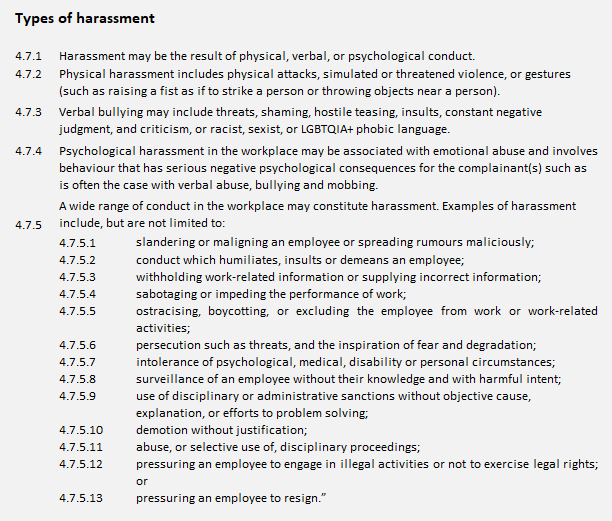
The following extract from the Code gives an idea of just how broad the general definitions of harassment are –
What is “sexual harassment”?
Again, the definitions here are extremely wide and include any form of unwanted conduct of a sexual nature including physical, verbal, or nonverbal conduct, whether expressed directly or indirectly. Specific examples that seem to have attracted the most media attention include sexual innuendos, comments with sexual overtones, sex related jokes, whistling of a sexual nature, sexually explicit texts, and “unwelcome gestures”, but there are many more.
What about “racial, ethnic or social origin harassment”?
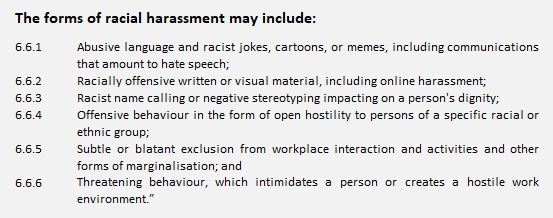
Again, the definitions are wide here, including the concept that “Racial harassment is unwanted conduct which can be persistent or a single incident that is harmful, demeaning, humiliating or creates a hostile or intimidating environment” and illustrated by this extract from the Code –
Bottom line: If you think something could possibly be classified as “workplace harassment”, it almost certainly will be! Disclaimer: The information provided herein should not be used or relied on as professional advice. No liability can be accepted for any errors or omissions nor for any loss or damage arising from reliance upon any information herein. Always contact your professional adviser for specific and detailed advice.

© LawDotNews

Fired For Moonlighting

By | Employment and Labour Law
“She failed to disclose these obviously material activities to her employer and was therefore manifestly acting in violation of her duty of good faith to her employer.” (Extract from judgment below)
“Moonlighting” is the practice of employees boosting their monthly income with a “side-job” or “side-business”. It has been a feature of working relationships since the dawn of history, but now the pandemic lockdowns and the shift to the “gig economy” (where independent contractors and freelancers are paid for short-term assignments) have seen dramatic increases in the number of employees forced to supplement their incomes in this way. Some stats suggest that now almost half of all employees have a second source of income, and both they and their employers need to take note of a recent Labour Appeal Court decision confirming the dismissal of an employee for failing to disclose her side-business to her employer.
Selling biltong secretly
  • A sales agent for a meat products company was found to be running her own “formal business” (with at least one full-time employee and from rented premises) selling biltong over weekends. She had not only kept that fact from her employer but had positively stated in a letter to it that she had no source of income other than her salary and maintenance from her divorce.
  • Found guilty of dishonesty because she failed to advise her employer of her side-line business, she was dismissed.
  • She referred an unfair dismissal dispute to the CCMA (Commission for Conciliation, Mediation and Arbitration) and, long story short, she ended up before the Labour Appeal Court which confirmed her dismissal, finding that –
    • “[She] failed to disclose an essential and important fact that she was running ‘a side-line business’ in the market for the sale of meat products, albeit that they might not have been identical to the meat products which were sold by [her employer]”.
    • “That she was able to discharge her duties to [her employer]” does not take her case any further.”
    • The CCMA’s conclusion that “employees act in bad faith if conflict of interest may arise even though no real competition actually results” was, held the Court, unassailable.
    • “She was employed as a sales representative in a business that was involved in the sale of meat products. As a side-line business, she conducted a business which involved the sale of biltong, namely a meat product. She failed to disclose these obviously material activities to her employer and was therefore manifestly acting in violation of her duty of good faith to her employer.” (Emphasis supplied).
A note for employers…
Avoid any doubt in your workplace with a clear, balanced and fair policy on the question of employees holding second jobs or running “side-hustles” and include a clause to that effect in your employment contracts. Professional advice is vital given the stakes in any labour law dispute.
And a note for employees…
Many employers will be very understanding if you are totally honest with them about any moonlighting you get involved in, whether it’s through economic necessity or just a desire to pursue something you are passionate about. Disclose everything in writing (keep proof!), whether or not you will be impinging on your working hours. You risk dismissal even if there is “no real competition” with your main job, and even if your work performance is not impacted – it’s the “bad faith” element of secreting your side business that will sink your case. Disclaimer: The information provided herein should not be used or relied on as professional advice. No liability can be accepted for any errors or omissions nor for any loss or damage arising from reliance upon any information herein. Always contact your professional adviser for specific and detailed advice.

© LawDotNews

Effective 1 March 2022: New Earnings Threshold and National Minimum Wage

By | Employment and Labour Law
Employers and employees need to keep an eye on the annual increases in both the National Minimum Wage and the Earnings Threshold, summarised below for your convenience. Both are effective from 1 March 2022.
The National Minimum Wage increase
The National Minimum Wage (NMW) for each ordinary hour worked has been increased by 6.9% from R21,69 to R23.19. To quote from Minister of Employment and Labour Thulas Nxesi’s announcement – “As in previous years, the adjustment provides exceptions for several worker groups, including:
  • Farmworkers are entitled to a minimum wage of R23.19 per hour.
  • Domestic workers are entitled to a minimum wage of R23.19 per hour.
  • Workers employed on an expanded public works programme are entitled to a minimum wage of R12.75 per hour.
  • Workers who have concluded learnership agreements contemplated in section 17 of the Skills Development Act, 1998 (Act No 97 of 1998), are entitled to allowances contained in schedule 2.
It is illegal and unfair labour practice for an employer to unilaterally change working hours or other employment conditions in order to implement the NMW. The NMW is the amount payable for ordinary hours of work and excludes payment of allowances (such as transportation, tools, food, or lodging), payments in kind (board or lodging), tips, bonuses, and gifts.”
Domestic workers
For the first time domestic workers have been brought into line with the NMW via a 21.5% increase from 2021’s R19.09 per hour. Assuming a work month of 21 days x 8 hours per day, R23.19 per hour equates to R3,895.92 per month. The Living Wage calculator will help you check whether or not you are actually paying your domestic worker enough to cover a household’s “minimal need”.
The Earnings Threshold Increase
The annual earnings threshold above which employees lose some of the protections of the Basic Conditions of Employment Act has been increased from R211,596.30 p.a. to R224,080.48 p.a. “Earnings” (for this purpose only) means “the regular annual remuneration before deductions, i.e. income tax, pension, medical and similar payments but excluding similar payments (contributions) made by the employer in respect of the employee: Provided that subsistence and transport allowances received, achievement awards and payments for overtime worked shall not be regarded as remuneration”. To quote again from the Minister’s announcement: “These sections protect vulnerable employees by regulating, among other things, working hours, overtime,… compressed schedules, working time, average hours of work, meals interval, daily and weekly rest periods, pay for work on Sundays, night work, and work on public holidays.” The threshold also impacts on some of the protections provided in the Labour Relations Act –
  • Employees earning less than the threshold, if contracted to a client for more than three months through a temporary employment service (“labour broker”) are deemed to be employed by the client unless they are actually performing a temporary service.
  • Fixed-term employees earning below the threshold are deemed to be employed indefinitely after three months unless the employer has a justifiable reason for fixing the term of the contract.
Turning to the Employment Equity Act, employees earning over the threshold can only refer unfair discrimination disputes (other than disputes based on sexual harassment) to the Commission for Conciliation, Mediation and Arbitration (CCMA) with the consent of all parties. Otherwise they must go to the Labour Court for arbitration. Disclaimer: The information provided herein should not be used or relied on as professional advice. No liability can be accepted for any errors or omissions nor for any loss or damage arising from reliance upon any information herein. Always contact your professional adviser for specific and detailed advice.

© LawDotNews

When Does Attendance at a Rugby Match Trigger a Dismissal from Employment?

By | Employment and Labour Law
“This is dishonest conduct of a kind which clearly negatively impairs upon a relationship of trust between an employer and employee.” (Extract from judgment below)
An all-too-common complaint in workplaces comes from employers who notice a sudden surge in employees calling in sick on the day of a major sports fixture, or perhaps just on a “good beach day”. So as an employer what can you do about it if your “sick” employee is captured on TV enthusiastically waving a patriotic flag in the stands at a test match, or is recognised by another beachgoer frolicking in the waves at Muizenberg? A recent Labour Appeal Court decision dealt with a case where the employee’s dishonesty about a “sick day” had clearly led to a breakdown in trust, which goes to the heart of any employer/employee relationship.
The sick leave claim, the rugby match and the dismissal
  • A “relatively senior” supermarket employee advised a manager that he had been taken ill and would not be attending work that day.
  • In fact it turned out that he had travelled to watch a rugby match in support of his local team. On his return to work he made no secret of this fact, openly telling his manager about it.
  • He was found guilty at a disciplinary enquiry on a charge of gross misconduct, and dismissed.
  • He had on previous occasions been disciplined for absence and for late arrival at work and although most of the warnings had expired, one was still in force at the date of his disciplinary hearing.
  • The employee took the matter to the CCMA (Commission for Conciliation, Mediation and Arbitration) which ordered his reinstatement, but eventually the matter ended up before the Labour Appeal Court, which, having noted that the case turned on the answer to the question “When does attendance at a rugby match trigger a dismissal from employment?”, confirmed the dismissal as being “clearly the appropriate sanction”.
  • The employer was justified, said the Court, in adopting the approach that the employee “was required to act with integrity and abide by the [employer]’s policies, procedures and codes”. The CCMA’s order of reinstatement was a “… lenient approach to dishonesty [which] cannot be countenanced.” As a mark of how seriously the Court viewed the employee’s dishonest conduct, it very nearly granted a costs order against him (which is rare, and reserved for cases of “egregious conduct”).
  • Critically, the Court found that the employer/employee relationship of trust had broken down as a result of the employee’s “initial unreliability and now dishonest conduct”. “He was palpably dishonest, even on his own version. He expected to get away with the enjoyment of attendance at a rugby match on the basis of claiming sick leave and then enjoying the benefits thereof. This is dishonest conduct of a kind which clearly negatively impairs upon a relationship of trust between an employer and employee.” (Emphasis supplied).
The bottom line for employers is to act firmly in cases of employee dishonesty (as always, the intricacies of this area of law are such that specialist professional advice is essential) and for employees this case is yet another warning shot from our courts to the effect that dishonesty affecting the employer/employee trust relationship could well cost you your job. Disclaimer: The information provided herein should not be used or relied on as professional advice. No liability can be accepted for any errors or omissions nor for any loss or damage arising from reliance upon any information herein. Always contact your professional adviser for specific and detailed advice.

© LawDotNews

Fired for a Racist Facebook Post

By | Employment and Labour Law

“The seriousness and gravity of offences involving racism and racial hatred cannot be over-emphasised. Employers are under a duty to provide a safe working environment and to protect all employees from harm, whether physical or emotional, whether they are black or white. An employer can be held liable for failure to take any action against its employees who are guilty of such conduct. South Africa is a country plagued by a history of racism and violence and social media plays a significant role in the incitement of racial hatred and violence. The power of such posts on social media inciting racial hatred cannot be undermined.” (Extract from judgment below)

Here’s yet another warning from our courts to tread with extreme care when posting anything online. Social media channels (particularly it seems Facebook) are favourite arenas for insults, threats and incitements to hatred and violence.

“Think before you post” is the only safe option here. Misusing social media unlawfully is dangerous for anyone and at any time – a damages claim for defamation or a subpoena from the Equality Court could be the least of an offender’s worries. 

When it comes to employees, the spectre of summary dismissal will always loom large if any form of racism or other serious misconduct is involved.

A recent Labour Court decision illustrates –

Off duty, but still dismissed for a racist Facebook comment  
  • A “general worker” with 10 years’ service in a high-profile company with a multicultural workforce posted a comment on the Eyewitness News Facebook page that all white people must be killed (“Whites mz b all killed”) and was charged at a disciplinary enquiry with two offences –
    • Making a racist comment on social media, and
    • Thereby acting contrary to the interests of his employer.
  • At the disciplinary enquiry, the employee denied that he had posted the Facebook comment and claimed that his Facebook page had been hacked.
  • Found guilty on both charges, he referred a dispute to the CCMA (Commission for Conciliation, Mediation and Arbitration), alleging unfair dismissal. It was at this stage that he changed his story to admit that he had in fact made the offending Facebook post.
  • The commissioner ultimately upheld the dismissal as both substantively and procedurally fair, a decision taken on review by the employee to the Labour Court.
  • The Labour Court dismissed the review application, finding firstly that even if the employer had had no disciplinary code in place “any employee would know that it was an extremely serious offence for a member of one race group to call for the killing of all members of another race group.” In any event, the employee had in fact been trained in the employer’s disciplinary code, and that prescribed dismissal for the offence of racism.
  • The employer had a duty to protect its employees from racist misconduct and had “consistently charged people for offences involving racism. The last employee that had been dismissed for racism was charged and dismissed for using the “K” word.”
  • It was irrelevant that the employee had made the Facebook post outside his workplace and outside his working hours as “it is the attitude that persists which, when on duty, affects the employment relationship.”
  • He had also exposed his employer to a risk of reputational damage and had acted contrary to its interests as per the second disciplinary charge.
  • The employee’s dismissal stands.

Disclaimer: The information provided herein should not be used or relied on as professional advice. No liability can be accepted for any errors or omissions nor for any loss or damage arising from reliance upon any information herein. Always contact your professional adviser for specific and detailed advice.

© LawDotNews
Employers – Walking the “Compulsory Covid-19 Jab” Tightrope

By | Employment and Labour Law

“Employers should find a reasonable resolution that accommodates all parties where employees refuse to be vaccinated for medical and constitutional grounds” (Ministry of Employment and Labour)

As the Covid-19 pandemic continues to wreak havoc around the world, an increasing number of businesses find themselves walking a tightrope between their obligations to, on the one hand, both protect the public and provide a safe and healthy workplace, and on the other hand to respect the individual constitutional rights of employees to make their own choices in matters of bodily and psychological integrity, religion, belief and opinion.

These deeply conflicting rights and obligations have left employers asking themselves questions like: “Must we insist on our employees having the vaccination to protect their colleagues, our visitors, our customers and the public at large?” and “If so, can we actually force unwilling employees to get jabbed or are we in for unfair practice or wrongful dismissal claims?”

The Minister’s “Amended Consolidated Direction”

On 11 June 2021 the Minister of Employment and Labour issued an “Amended Consolidated Direction on Occupational Health and Safety Measures in Certain Workplaces” under the National Disaster Regulations in an attempt to address those questions.

The Direction is long, detailed and complex, setting out a host of “minimum measure” requirements for workplace safety during the pandemic, so specific professional advice is essential here. But in a nutshell there is now an official guideline for employers wanting to make vaccination compulsory or partially compulsory. At a minimum, comply with all these specified obligations –

  1. Undertake a risk assessment
    This risk assessment (supposed to have been completed by 2 July 2021) was to determine (a) whether vaccinations were to be made mandatory considering the “operational requirements of the workplace” and if so (b) who was to be compulsorily vaccinated, taking into account the risk of transmission to employees through their work and their risk for severe Covid-19 disease or death due to their age or co-morbidities.In assessing whether or not your particular workplace needs a mandatory vaccination policy, include factors such as the ongoing requirement to enable employees to work from home where possible (still applicable even under Adjusted Level 1), the nature of the work in question, whether adequate ventilation is possible, whether adequate social distancing measures are possible and so on – the list is endless.As regards that 2 July deadline, it seems likely that many (perhaps most) employers missed it. If you are in that boat, what should you do now? There is no clear guidance on that, but the consensus of expert opinion seems to be that you should still comply, as soon as possible.
  2. Develop or adjust a vaccination and protective measures plan
    Based on the risk assessment, this plan must outline both what protective measures you have in place, and what vaccination measures you intend to implement.
  3. Consult on the risk assessment and plan
    Consultation must be with any representative trade union and any health and safety committee or representative. We should discuss under this heading also the questions of communication, education and training. We all know that together with some rational and valid concerns, there is an avalanche of fake news around Covid-19 and vaccinations. Inform your employees fully of their rights, help them to distinguish fact from fake, address their individual fears and concerns, explain the benefits of your plan to everyone, and strive for consensus.
  4. Make the plan available
    The plan must be available to an Occupational Health and Safety Act inspector and to the person/s listed in point 3 above.
  5. Other requirements and factors
    No list of this nature can ever be comprehensive but consider factors such as paid time off and transport to vaccination sites, sick leave for employees who suffer side-effects, counselling for “vaccine hesitant” employees and the like. There are also defined procedures to be followed when employees raise medical or ethical objections to being vaccinated (for example, the employer may need to try to find an alternative position in the business for such an employee). 

    And of course every workplace will be different, which leads us to …

The bottom line

There is talk of workplace vaccination being officially made compulsory either across the board or in certain sectors, whilst media reports suggest that an increasing number of large employers are already implementing compulsory vaccination policies on the basis of legal advice received. There is also much speculation that our courts will support dismissal of employees who refuse vaccination in appropriate cases, and there is even a report of a High Court Judge insisting on either proofs of vaccination or negative PCR tests “for the general well-being of all parties in attendance at court”.

Bear in mind however that every situation, every workplace, and every employee will be unique – and with the high stakes involved, tread with extreme care and only after taking professional advice.

Disclaimer: The information provided herein should not be used or relied on as professional advice. No liability can be accepted for any errors or omissions nor for any loss or damage arising from reliance upon any information herein. Always contact your professional adviser for specific and detailed advice.

© LawDotNews
A Million Rand Warning: Act When Employees Reach Retirement Age

By | Employment and Labour Law

“Retirement is for people who don’t like their jobs” (Paul McCartney)

Many employees reaching “retirement age” (often set at 60 or 65) are not ready to retire. Perhaps they need to carry on earning an income, often they are fit and healthy and want to remain engaged and productive. Increasingly, both factors are at play.

Regardless, the concepts of an aging workforce and “65 is the new 50” are here to stay, and employers and employees alike need to tackle the changing realities that come with them.

Agree a retirement date upfront!

Firstly, do not as an employer make the mistake of not specifying an agreed retirement age in your contracts of employment. Without such a clause you run the risk of being found guilty of “age discrimination” if in due course you force an unwilling employee to retire. As that is a class of “automatically unfair” dismissal, you are likely to pay dearly for your mistake.

Let’s consider however a recent case where an agreed retirement age was in place, but it came and went unnoticed (or perhaps noticed but ignored) …

The engineer who carried on as usual after 65
  • An engineer’s 1985 written contract of employment provided that his employment would terminate at the end of the month when he reached the age of 65 unless the parties agreed otherwise in writing. It also had a standard “no-variation-except-in-writing” clause.
  • He turned 65 in 2013 but continued working as normal, uninterruptedly, until he accepted a voluntary retrenchment in 2017. He had shortly before retrenchment been offered a two-year fixed-term contract which provided that he would not receive “any discharge or severance benefits” upon its termination – wisely, as it turned out, he had rejected that offer.
  • When the business thereafter offered all employees a voluntary retrenchment package of one week’s compensation for every year of service, the engineer accepted. So far so good, but the problem arose at payout time. He was offered only 4 weeks’ compensation and was told that he had officially retired at 65 so only his post-retirement pay was taken into account in calculating his severance package.
  • The employee was having none of that and demanded a recalculation based on his service since 1985. He took the dispute to the CCMA (Commission for Conciliation, Mediation and Arbitration), claiming for 29 weeks as the balance due after he had accepted the 4 weeks as part payment only. The CCMA awarded him the full amount (R1,010,625) and the Labour Appeal Court in due course confirmed the award.
Learning from the employer’s R1m lesson

The Court based its decision on its conclusion that although the 1985 employment contract had terminated when the employee had turned 65, he had carried on working “seamlessly” thereafter.

In terms of the Basic Conditions of Employment Act, length of service must take into account previous employment with the same employer if the break between the periods of employment is less than one year. In this case, said the Court, there was no break at all and the engineer’s “employment with the respondent was ‘continuous’, in the true sense of that term.”

The employer’s mistake seems therefore to have been that it had done nothing when its employee approached the agreed retirement age. The reason for it doing nothing is unclear, but one wonders how many employers ever bother to diarise all retirement dates with a note to take action before they arrive.

Regardless, through its lack of action the employer effectively landed itself with an open-ended contract of employment (i.e. with no agreed retirement or termination date). If it had been more alert it could perhaps have simply said “remember you retire soon, enjoy your retirement” – that would not have been a retrenchment, and no severance pay would have been payable. Perhaps it could then have safely offered the employee a new fixed-term contract for a specified period (a “clean break” would have been essential i.e. no untaken leave or the like carried forward from the original contract). Perhaps it could even have structured an agreement to extend the contract on terms that would have made it unnecessary to give the employee a retrenchment package at all. Every case will be different and there are grey areas in the applicable law, so specific professional advice is essential here.

Disclaimer: The information provided herein should not be used or relied on as professional advice. No liability can be accepted for any errors or omissions nor for any loss or damage arising from reliance upon any information herein. Always contact your professional adviser for specific and detailed advice.

© LawDotNews