All Posts By

Kruger & Co

Can You Sue a Bad Investment Advisor? It depends…

By | Delict and Civil Claims, Personal Finance

“I always advise people never to give advice” (P. G. Wodehouse)

If you want to send shivers down the spine of any investor, mention “Steinhoff”, or “Sharemax”, or any one of the many other spectacular corporate collapses that have plagued both local and overseas investors in recent times.

Quite apart from the high-profile failures it’s been a hard few years for investors generally, and if your nest egg has taken a painful tumble recently you may well wonder whether you can sue your financial advisor for giving you bad advice.

The short answer, as several recent cases have highlighted, is “It depends…”.

Case 1: A R2.5m claim succeeds
  • A widow, still reeling from her husband’s death and unversed in financial products, invested R2m in Sharemax on the advice of her trusted financial advisor, an authorised Financial Services Provider (FSP).
  • She made it clear that she needed a safe, low risk investment and “that she could not risk losing even two cents as the money was earmarked for her son’s upbringing”.
  • The advisor did not explain any other investment products and emphasized that “it was so good that he did not even want to introduce other financial instruments and/or investments to her.”
  • Sharemax of course collapsed, and the investor duly sued the advisor for her R2m plus interest – a total of almost R2.5m by the time this case found its way through the High Court and an appeal to the Supreme Court of Appeal (SCA).
  • The advisor was found liable on the basis of having been negligent “and even dishonest” and to have “failed to exercise the degree of skill, care and diligence which one is entitled to expect from a FSP”.  
Case 2: An R11m claim fails
  • A UK couple temporarily in South African sought a local financial advisor’s advice on how best to invest some “spare cash”.
  • They ended up putting GBP 565,000 and R700,000 (about R11m in all) into investment products offered by UK based investment companies. The companies failed and the investments were rendered worthless.
  • The investors successfully sued the advisor in the High Court for R11m in damages, but on appeal to the SCA their claim was dismissed.
  • The investors, said the Court, had failed on the evidence to “identify what a reasonably skilled financial service provider would know about products in the market place; what due diligence they would have done before making a presentation to a prospective client and what sources of information they would have consulted.” They had failed to prove that any negligence on the advisor’s part in “making a presentation without adequate knowledge of the proposed investments, resulted in advice materially different from that which a reasonably competent advisor would have given.” (Emphasis supplied).
  • End result – the investors lose their R11m and face a (doubtless substantial) legal bill. 
Case 3: A R5m claim fails

To the High Court now for some insight into the range of factors that a court is likely to take into account in deciding liability – 

  • This was another Sharemax investment, this time for R5m.
  • The difference was that this investor was found to have been an astute and wealthy businessman who managed his own share portfolio and went into the investment understanding the risks and “with his eyes open” after taking independent advice.
  • Claim dismissed.
The bottom line, and some advice for investors

Let’s start off with this thought – unless you are fully qualified to make your own investment decisions, seeking help from a financial advisor is a no-brainer. A trained and certified professional advisor brings elements of insight, knowledge and objectivity that you can never match on your own.

Just be sure that your chosen advisor is the right advisor for you and is both competent and trustworthy. As a first step check for FSCA (Financial Sector Conduct Authority) authorisation (and a list of products the advisor is approved to provide) here.

If worst comes to worst and you feel that your advisor has let you down and should refund you, the bottom line (in a nutshell) is that to successfully sue you will have to prove that you suffered loss in consequence of following your advisor’s negligent advice.

The million dollar question (literally perhaps) is of course – how do you establish that necessary element of negligence? Whilst it will never be easy, and whilst each case will be treated on its own merits, the SCA (in the R11m case above) usefully held that an advisor’s legal duties are mirrored in the FAIS (Financial Advisory and Intermediary Services) Act and its Codes of Conduct. So perhaps start off by proving a breach of the General Code of Conduct’s provision that “an authorised financial service provider ‘must at all times render financial services honestly, fairly, with due skill, care diligence and in the interests of clients and the integrity of the financial services industry‘.”

There’s also the FAIS Ombud option

You may not need to go to court to recover your losses, in that the “FAIS Ombud” (Ombudsman for Financial Services Providers) has the power to resolve complaints against FSPs. It can award “fair compensation for the financial prejudice or damage suffered” up to its jurisdictional limit of R800,000. In at least two Sharemax complaints, compensation orders have been issued, but many more have been dismissed.

Ask your lawyer which route is best for you.

And last but not least, some advice for financial advisors

Make sure that all your documentation protects you from liability as much as possible, that you have insurance cover in place in case you are sued (in the R2.5m case mentioned above, the insurers were ordered to indemnify the advisor against the claim), and that you comply strictly with FAIS and its Codes.

Disclaimer: The information provided herein should not be used or relied on as professional advice. No liability can be accepted for any errors or omissions nor for any loss or damage arising from reliance upon any information herein. Always contact your professional adviser for specific and detailed advice.

© LawDotNews

Report Your Traffic Accident with an Online Reporting Service

By | General Interest, Road Traffic

Traffic accidents, your fault or not, are traumatic affairs. Even minor dings come with their hassles – panel beaters, tow trucks, shock and recriminations, reams of paperwork, having to get a Crash Report Number for the insurers…

That last bit has always been a major added stress factor, requiring a trip to the local police station (unlikely to be a happy experience) and yet more paperwork. 

No longer – life just got a little bit easier with the new online reporting service from NaTIS (the National Traffic Information System) on its website here. The submission of the report is legally binding and only applies to “minor damage crashes”, not in cases of injury or death. Note the time limit – “All crashes must be reported within 24 hours or the next working day. (Non-Working days Saturday, Sunday and Public Holidays).”

Get your lawyer’s help urgently if it’s anything but a minor accident!

Disclaimer: The information provided herein should not be used or relied on as professional advice. No liability can be accepted for any errors or omissions nor for any loss or damage arising from reliance upon any information herein. Always contact your professional adviser for specific and detailed advice.

© LawDotNews

Your Website of the Month: Become a Client Whisperer

By | Business, Website of the Month

“It takes seven times more money, effort and time to get a new client than it does to keep an existing one”

We’ve all heard of “dog whisperers”, “cat whisperers”, “horse whisperers”, even “elephant whisperers” – but “client whisperers”? Is that even a thing?

It is, and with your clients being the lifeblood of your business, retaining them is fundamental to its profitability and success. For a take on how to do that – to your mutual benefit – read “The Client Whisperer” on the CleanFax website.

The article specifically addresses carpet cleaning businesses but the principles it espouses, and the advice it gives, are universal. They apply to every type of business you can think of. 
So protect your client base – become a client whisperer!

Disclaimer: The information provided herein should not be used or relied on as professional advice. No liability can be accepted for any errors or omissions nor for any loss or damage arising from reliance upon any information herein. Always contact your professional adviser for specific and detailed advice.

© LawDotNews

Before You Start a New Small Business in 2020…

By | Business

“Just do it!” (Nike)

You and your fantastic business idea can’t wait to chuck up the 9 to 5 job and launch your own new venture. 2020 here we come! But is this the right time to do it?

Of course no one knows for sure whether 2020 will see our economy glide happily into recovery mode or continue bumping along in the mud at the bottom. But one of the great things about starting a new small business is that it doesn’t really matter. Provided, that is, that you plan carefully and remain agile and adaptive to whatever may come our way.

Here are some thoughts on how to get that planning underway…

1. Line up the right professional help

Quite apart from all the many legal, accounting and tax-planning issues you will face, bouncing your ideas off your professional advisers is a no-brainer here. Just do it before you put too much time, effort and money into your new venture. 

More on that below…

2. Ask yourself “Am I an entrepreneur?” 

Not everyone is suited to the cut and thrust of running a small business. On one side of the coin you can look forward to a good dose of exhilaration and excitement, but on the other you are in for more than your fair share of work-life balance challenges, risk, fear and stress. The personal and financial rewards can be enormous, but the spectres of disruption, decline and failure will haunt you at every turn (if they ever stop haunting you, something’s wrong – nothing is certain, and nothing lasts forever!).

Bring your family in on this from the very start – they will be walking this road with you every step of the way! 

3. Quiz yourself online

Spend 10 minutes answering the questions in an online quiz like the Business Development Bank of Canada’s “Entrepreneurial potential self-assessment” on its website – then book appointments with your professional advisers to see if they agree (back to 1 above). 

4. Decide on a business structure upfront

This is critical; the tax, financial, legal and practical issues of getting it wrong can be substantial. And whilst you can change from say sole proprietorship to a company/trust structure down the line, the consequences are best avoided. Rather get it right from the outset with professional advice (1 above again).

5. Figure out the financing

Whether you will need a lot of money upfront or not, your business idea is a non-starter without finance. First, figure out how much you will need – crowdfunding site Kickstarter has a useful planning checklist on its “Funding” webpage.

Next think about where that money is coming from. Can you finance the startup yourself; and if you can, should you? Will you ask friends and family or a bank for a loan? Perhaps you can find a rich partner or an angel investor? Crowdfunding may be worth a look – apart from Kickstarter and many others like it, consider local platforms – Google “Crowdfunding in South Africa” for a list, and read Jumpstarter’s “Crowdfunding in South Africa!” here. The State also comes to the party here – read “Where do I get assistance to establish a small business?” on the South African Government Information website for a list.

Last but not least, specific professional advice is once again a no-brainer. 

6. Build a strong, dynamic team

Your staff will be the backbone of your business so whether your team will be big or small, in-house or out-sourced, management-heavy or mostly there in a support function, put your heart and soul into choosing wisely. Recruit wherever you can from diverse backgrounds and a range of specialties for a dynamic team that is agile and adaptable, and has the creativity that flows from constant cross-pollination of ideas.

7. Market, market, market!

No matter how brilliant your product or service, it is worth absolutely nothing to you until your target market pays you for it. Which it will only do if it knows what you do and how you benefit them. As obvious as that sounds a lot of startups fail for lack of planning around how to achieve the necessary exposure.

With all the marketing noise bombarding us all these days you have to find a way to be heard – prioritise marketing or fail.

8 . For a company get cracking with Biz Portal’s ‘One-Day, One-Stop’ online platform

The CIPC (Commission for Intellectual Property Commission) has just launched its “Biz Portal” online business registration platform. In collaboration with SARS, UIF, the Compensation Fund, B-BBEE Commission, the .za Domain Name Authority, and banks, the platform says it will help you register your new company in just 1 day (it normally takes 40!), plus assist with tax registrations, domain names, bank account, BEE certificate and so on.

Time will tell how effectively this (very welcome!) new initiative will actually work, but remember that by its very nature it cannot give you that essential individualised input we keep mentioning. Take professional advice as above before using this platform!

9. The bottom line: Just do it!

To quote Richard Branson: “Screw it – just do it!” 

Disclaimer: The information provided herein should not be used or relied on as professional advice. No liability can be accepted for any errors or omissions nor for any loss or damage arising from reliance upon any information herein. Always contact your professional adviser for specific and detailed advice.

© LawDotNews

Must You Pay Tax on Your Rental Income?

By | Property, Tax

“Few of us ever test our powers of deduction, except when filling out an income tax form” (Laurence J. Peter of The Peter Principle)

Letting out property can give you an excellent “annuity” income, and if that concept appeals to you and a buy-to-let property comes your way at the right price put an offer in right now; before the current ‘buyer’s market’ runs its course.

In your financial planning however remember the tax implications, because as a landlord you must add your rental income to your salary and other taxable income in your tax return every year. Not to do so is tax evasion, and that carries heavy financial penalties as well as the very real threat of criminal prosecution. 

Having to pay tax on your rental income could be make-or-break when it comes to deciding on how much you should pay for a particular property, so do your homework before you put your offer in.

Our tax laws are complex and specialised, so professional advice on your particular circumstances is essential here. These general concepts will however help you in your initial planning –

You must declare all property rental income

You must declare your gross rental income to the taxman whatever type of accommodation you rent out – whether a whole house or apartment, just a room/garden flat or anything similar – or if you are in the guesthouse/B&B/Airbnb business.

You can claim some expenses, but not all

Your taxable income will be calculated by subtracting allowable deductions from your gross income.

In general, only “expenses incurred in the production of that rental income can be claimed” (SARS). So you can claim things like levies, rates and taxes, bond interest, advertising, agent’s fees, homeowner’s insurance, garden services, electricity and water, repairs and maintenance to the leased area (which would, says SARS, “usually take place when a person attempts to restore an asset to its original condition as a result of damage or deterioration”). Beware the “beginner’s mistake” of thinking that your full bond repayment instalments are deductible – not so, only the interest portion can be claimed and not the capital repayments.

In regard to VAT (per SARS): “The supply of accommodation in a dwelling is an exempt supply for VAT purposes, and consequently you may not deduct VAT incurred on expenses in respect of supplying accommodation in a dwelling.” 

And when it comes to renting out only a portion of a property (a room say in the house you live in) you can only claim pro-rata to total floor area. Click here for a practical example from SARS.

Take advice also on claiming depreciation on furniture and the like – your allowable deduction there might be worthwhile.

Not allowed are “expenses that are capital in nature or that are not in the production of rental income” (SARS). So the cost of improvements to the property – which would normally “result in the creation of a better asset” (SARS) – cannot be claimed. Improvements can however be added to the “base cost” of your property – important when you come to pay CGT (Capital Gains Tax) on eventual disposal.

How are you taxed, and what about “ring-fencing”?

Your total taxable income (i.e. including net rental income) will be taxed as per current tax tables.

What if your letting business shows a loss? Per SARS – “should the expenses exceed the rental income, the loss should be available for set-off against other income earned by the individual, provided that the loss is not “ring-fenced” in terms of prevailing anti-avoidance provisions”. In other words SARS could ring-fence your letting business losses to stop you from setting them off against your regular non-rental income. But if that happens you don’t lose those losses, they are just carried forward so that when your letting business starts turning a profit the losses can then be set off against that profit.

Keep an eye also on your obligation to register for and pay provisional tax. As an individual if you earn taxable income of R30,000 p.a. or more in “rental from letting of fixed property” you fall into the net.

Keep full records from Day 1!

Create and maintain a full spreadsheet, with a file of supporting documents, of all income and expenditure (distinguish between revenue and capital, claimable and not claimable). It’s a relatively painless exercise if you update it regularly, but a real challenge if you end up trying to recreate everything only when the annual “income tax return panic” sets in, or when SARS and/or your accountants call for breakdowns and documentation. 

Disclaimer: The information provided herein should not be used or relied on as professional advice. No liability can be accepted for any errors or omissions nor for any loss or damage arising from reliance upon any information herein. Always contact your professional adviser for specific and detailed advice.

© LawDotNews

Your Written Contract Should Cover Everything – No Oral Evidence Allowed!

By | Contract, Litigation

Here’s another warning from our courts to make sure that all your contracts are properly drawn to reflect both accurately and fully what you have agreed to.

The problem with leaving anything out – or agreeing to something that isn’t then fully recorded in your contract – is a principle in our law known as “the rule of parol evidence”. 

A recent SCA (Supreme Court of Appeal) decision illustrates the rule in action, and the facts will resonate with the many farmers, businesses and city dwellers facing empty dams in drought-stricken areas…

The water diviner and the “insufficiently yielding” borehole
  • A fruit farm/wine estate accepted a quote from a contractor to drill a borehole.
  • The contractor, having successfully used his water divining skills and over 20 years’ experience to locate a good drilling spot, quoted to drill on the basis of his standard “No Water, No Pay” policy. The farm accepted the quote with a modification requiring a drill to 70m (or 100m if no water was found at 70).
  • The resultant 76m deep borehole yielded some 4,000 litres of water per hour – something which, as the Court put it, “would put a smile on the face of most farmers in this country”. 
  • Nevertheless, and despite the borehole “gaily being used by the [farm] to irrigate its orchards”, the farm refused to pay the drilling contractor a cent, arguing that the water yield was insufficient to meet the contractor’s agreed obligations.
  • One long (and no doubt expensive) legal battle through the courts later, the fight ended up before the SCA.
  • One of the farm’s defences to the claim (and the one relevant to this article) was its (hotly denied) insistence that the contractor had guaranteed a minimum water supply of 10,000 litres per hour.  
Oral evidence disallowed – it’s the written contract that counts
  • Bad defence, said the Court. A guarantee of water yield “is not what the agreement says, and to find that there was agreement on such a guarantee would breach the rule of parol evidence which prescribes that where the parties to a contract have reduced their agreement to writing, it becomes the exclusive memorial of the transaction; and no evidence may be led to prove its terms other than the document itself, nor may the contents of the document be contradicted, altered, added to or varied by oral evidence.” (Emphasis supplied). 
  • On that basis “the considerable volume of evidence led by both sides in regard to their negotiations and what their intention had been was all clearly inadmissible”. All that mattered was that the contract specified that payment was due if the borehole produced water and wasn’t “dry” – its actual yield was irrelevant.
  • The farm also tried to rely on the “partial integration rule” whereby, when a contract is partially written and partially oral, evidence can be led to prove the oral part of the agreement. But, held the Court, that rule cannot be used to “contradict or vary the written portion” of the agreement – which is exactly what the farm was trying to do. 
  • End of that argument, so the farm must pay its borehole bill in full, plus legal costs.

The bottom line – make sure your contracts cover everything both clearly and comprehensively!

Disclaimer: The information provided herein should not be used or relied on as professional advice. No liability can be accepted for any errors or omissions nor for any loss or damage arising from reliance upon any information herein. Always contact your professional adviser for specific and detailed advice.

© LawDotNews

January is “Divorce Month”: Beware the Dangers of DIY

By | Family Law

January is “Divorce Month”: Beware the Dangers of DIY

“What’s the only thing divorce proves? Whose mother was right in the first place” (Anon)

The festivities are over, the bills are coming in and everyone is returning to reality. Couples who for most of the year only have to live with each other after work hours, have suddenly spent a whole lot more 24/7 time in each other’s close company. Little irritations have magnified, habits have got on each other’s nerves, in-laws visiting for the annual family bun fight have heightened tensions…

Whatever the reasons, and whether only one party was at fault or both, January’s worldwide reputation as “divorce month” applies equally here in South Africa. Which means that the legal and personal risks associated with divorce are peaking now, in January.

On the legal side of things a particular risk to be aware of is the temptation for couples splitting on an “uncontested” (i.e. by mutual agreement) basis to opt for a “DIY” divorce. 

Beware, that’s a siren’s call…

The dangers of a DIY divorce

Divorce is full of both legal and practical pitfalls, and any mistakes a divorcing couple makes now could well live with them, their children, and their extended families for life.

The hard fact is that whilst DIY divorce may seem affordable and workable, specific legal assistance and guidance is worth every cent it costs – and particularly in uncontested matters the cost of proper legal help certainly won’t break the bank. Without such advice, the average couple risks the exact opposite of “affordable” in the form of a great deal more expense (not to mention stress and heartache) than had they consulted an attorney upfront.

To illustrate some of the many relevant issues the couple must take into account –

  1. Formalities: Getting divorced means complying with a list of formalities and requirements, and appearance in either the High Court or the Divorce Court. Getting anything wrong here is a recipe for disaster.
  2. Consent paper: A settlement agreement (often called a “deed of settlement” or “consent paper”), setting out what the couple has agreed to regarding children, maintenance, division of assets etc, should be made an order of court to give it the status of an enforceable judgment. The agreement should cover everything important, clearly and unambiguously – overlooking something vital (easy for the layperson to do) will come back to haunt everyone.
  3. Children: The most vulnerable parties in any familial breakup, children enjoy special protections in our law, and parents need to take into account questions of parental responsibilities and rights including “care and contact” (the new terms for “custody and access”), guardianship, maintenance, formal “parenting plans”, health care and the like.
  4. Maintenance: In addition to child maintenance, one spouse may have a claim on the other for spousal maintenance, either on an interim basis or longer-term.
  5. Financial implications and division of assets: Particularly where valuable assets are involved (a house or other property perhaps, or rights to a pension fund) the divorcing couple should agree on a split, on how property transfers will work, who will pay for what, who will assume financial obligations like home bonds etc. Which “marital regime” the couple was married under becomes important here, as does the question of whether or not there is an ANC (ante-nuptial contract) in place. A whole host of other legal and practical issues are also at stake. 
A final thought on controlling costs…

If you have a particular need to control costs, be open with your attorney and ask for advice on whether you can minimise them in any way.

Disclaimer: The information provided herein should not be used or relied on as professional advice. No liability can be accepted for any errors or omissions nor for any loss or damage arising from reliance upon any information herein. Always contact your professional adviser for specific and detailed advice.

© LawDotNews

Your Website of the Month: Be (Cyber) Safe in 2020!

By | Website of the Month

“The email of the species is deadlier than the mail” (Stephen Fry)

Cyber-attacks in South Africa increased by 22% in 2019, and our exposure to serious online security breaches increases exponentially in line with our increasing use of email. 

The fact is that we are all of us under attack by cybercriminals who become cleverer by the day at identifying our email vulnerabilities and at exploiting them. Defend your business with the tips in “Email in the age of cybercrime” on the LexisDigest website

The whole article is a goldmine (particularly the “quick guide to email security” section) so share it now with your colleagues and your staff, and diarise monthly reminders!   

Disclaimer: The information provided herein should not be used or relied on as professional advice. No liability can be accepted for any errors or omissions nor for any loss or damage arising from reliance upon any information herein. Always contact your professional adviser for specific and detailed advice.

© LawDotNews

Property Sales and Trusts: Demand Proof of Trustee Authority

By | Property

“If you want to make your house easy to sell, make it easy to buy” (Anon)

You are overjoyed at receiving a good offer for your property – not easily achieved in these hard times and of course you certainly don’t want to do anything to jeopardise the sale.

But perhaps do that little bit extra homework before accepting the offer if it comes from a trust. The pitfall here – and it’s one that perennially takes sellers by surprise – is that the trustee/s signing the offer to purchase/sale agreement must have the necessary authority to do so. Drop the ball on that one and you will find yourself without any sale at all.

As a seller learned to its cost recently in the Supreme Court of Appeal (SCA)…

For want of a second signature the seller goes down R3m 
  • In 2013 a company sold to a trust for R1.45m a “real right of extension” in a sectional title development (a right in this case to build on common property).
  • An agreement to sell a “real” property right of that type must, as with a standard property sale, be in writing and signed by both seller and buyer (or their authorised agents) to be valid.
  • The seller’s problem here was that only one of the trustees signed the sale agreement. The other trustee refused to sign, and in 2017 the seller found itself trying to convince the High Court to order the trust to pay it the R1.45m plus interest (by then a total just shy of R2m), alternatively to order the trustee who signed the deal to pay up personally in return for taking transfer into his own name.
  • The High Court however pointed out that where a trust has more than one trustee, they must act jointly, and a property sale agreement needs the signatures of all the trustees. One trustee signing alone would be regarded as an agent and would need either general authorisation in the trust deed or written authorisation to sign the particular agreement. Otherwise, as in this case, the signing trustee acted without authority and the sale was void.
  • Defeated in the High Court, the seller appealed to the SCA, abandoning its claim against the trust itself and now trying only to hold the signatory trustee liable in his personal capacity.
  • Its argument was that, despite the invalidity of the sale, the trustee was still liable – in his personal capacity – to pay and take transfer as he was guilty of breaching the clause (standard in property sale agreements involving corporates and trusts) that he “warrants and binds himself in his personal capacity by virtue of his signature hereto … that he is duly authorised to enter into this agreement on behalf of the company, close corporation or trust”.
  • No claim there, held the SCA, commenting that “The ingenuity of this argument is surpassed only by its lack of substance … what [the seller] is essentially seeking is specific performance of a void and invalid contract against the person who signed that contract but was not a party to it – this on the basis that if he’d had the authority to sign, which he had not, the property would have been sold to another. This merely had to be stated to be rejected.” This appeal, said the Court, was doomed to fail.
  • The end result – six years down the line the seller loses its claim (no doubt over the R3m mark including interest by now) and its legal bill will be a hefty one.
Could you sue the trustee personally for damages?

“Theoretically”, said the SCA, the signing trustee could be held liable to the seller for damages flowing from his breach of warranty, and that is of course a strong warning to those signing for trusts and companies – make 100% sure that you have full authority to do so!

But, said the Court, the seller in this case didn’t formulate its claim as a damages claim against the trustee personally and even it had, it would have had to provide evidence as to what damages it had actually suffered.

Indeed proving damages in a case like this is never going to be easy – the seller would have been much better off insisting upfront on proof of the trustee’s authority to sign alone.

As always, get professional advice before you sign anything.

Disclaimer: The information provided herein should not be used or relied on as professional advice. No liability can be accepted for any errors or omissions nor for any loss or damage arising from reliance upon any information herein. Always contact your professional adviser for specific and detailed advice.

© LawDotNews

Visiting South Africa with Kids Just Became Easier – Here’s What You Need to Know

By | Family Law, General Interest

“We’re all going on a summer holiday…” (Cliff Richard)

With the Festive Season (and our Summer Holidays!) well and truly upon us, you may be inviting family or friends to visit you from overseas with their children, or perhaps you are a foreigner planning a family trip to South Africa. Either way here’s some good news in the form of a welcome concession from government in regard to the documentation you will need to produce on entry. 

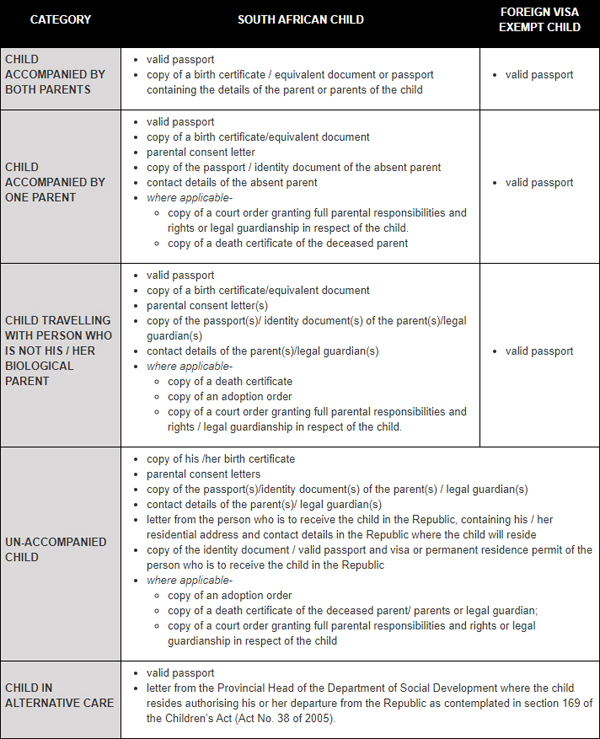
In a nutshell foreign children until now have only been able to enter the country with unabridged birth certificates and consent letters. That requirement was waived – for accompanied children only (check the full details in the table below) – from 8 November 2019. 

The Department of Home Affairs (DHA) says it has communicated this very welcome new development to all role players, most importantly to the immigration officials at ports of entry who are tasked with enforcing the rules, but if you do happen to have documentation handy it can’t hurt to bring it along in case of any queries. If you need visas to visit you will anyway have to produce the documents when applying.

South African children (and unaccompanied foreign children) must still provide a list of required supporting documents – see below.

Note that the above is just a summary – it is extremely important that you check the DHA table below for full details, and that you ask your lawyer for help if you think any exemptions may apply, if you have any difficulty in understanding what is required, or if you cannot get the necessary documentation together.

DOCUMENTS REQUIRED FOR CHILDREN TRAVELLING THROUGH A PORT OF ENTRY OF THE REPUBLIC

(Source – Department of Home Affairs)