© LawDotNews
© LawDotNews
Barely a week after a mystery ‘white knight’ offered creditors $4 million (R64 million) to bail out investors in the failed Africrypt scheme, another mystery investor has appeared with a better offer of $5 million (R80 million), equivalent to 65 cents in the rand.
The first offer made in November was also for $5 million, though only $4 million of that would go to creditors, with the remaining $1 million (R16.13 million) going to the running of the company.
Africrypt collapsed in April after its accounts were supposedly hacked and emptied of all funds. But it turns out this was not the first hack to have plagued the founders of Africrypt – brothers Raees and Ameer Cajee – and their investors.
As Moneyweb reported, a previous investment scheme of theirs was supposedly hacked in May 2019, causing more than a few Africrypt investors to suspect foul play. Two hacks in less than three years seemed a stretch too far for some investors, who suspect the Cajees are now using proxies to make an offer of compromise with the hope of avoiding jail time.
Read: Lightning strikes twice for Africrypt’s Cajee brothers
The latest offer of 65 cents in the rand is on investors’ deposited amount, not the current value of the ‘hacked’ bitcoin or Ethereum.
Investors who deposited into Africrypt in September 2019 would have paid about R120 000 for their bitcoin – which is today worth about R800 000.
This offer effectively means investors will be paid out less than R80 000 per bitcoin, for an asset that is worth 10 times that today.
Africrypt was run by the Johannesburg-based Cajee brothers, who solicited funds from investors by promising returns as high as 10% a day using a computerised trading algorithm.
These promises were even more outrageous than MTI’s claims of 0.5-1.5% returns a day.
MTI was placed in provisional liquidation a year after failing to pay out members’ requests for withdrawals. MTI also claimed to have a computerised trading algorithm, though no evidence of this was found by the Financial Sector Conduct Authority (FSCA) when it looked into it.
The Cajees disappeared around the time of the alleged hack, and are believed to be in the Middle East.
The first offer to buy out the claims of Africrypt investors made in November came with a catch: anyone accepting the offer would have to withdraw criminal charges against the Cajee brothers and their affiliated entities.
This condition was likely unlawful, and is referred to as ‘compounding’ in law, which is agreeing not to prosecute a crime in return for a reward.
The second rescue offer presented to investors last Friday (December 3) carries no obligation to withdraw criminal charges.
The first offer specified that the Cajees would be employed by Africrypt, which would be resuscitated as a trading entity so that investors could potentially earn back their full investment.
Investors hoped this would provide them with an opportunity to interrogate the Cajees as to the circumstances surrounding the alleged hack, and whether it was a genuine hack or an inside job. The Cajees have maintained the hack was genuine, and denied any involvement in what some believe was a heist, according to the BBC.
The identities of both the first and second ‘saviour’ investors remain unknown, though Ruann Kruger, legal representative for the Africrypt liquidators, says the second investor is a company.
“I am prevented from disclosing the identity of the company at this stage due to a non-disclosure agreement,” he tells Moneyweb.
“We have no idea of the identity of the first investor,” he adds.
Kruger says so far 35 out of 181 investors have signalled their intention to accept the offer.
Says a representative for some investors: “There are of course suspicions that this offer is coming via a proxy for the Cajees, and that we are being paid out with [our] own money. Either way, this is a clever tactic by whoever the investor is. It’s a divide [and] rule tactic.
“What I see happening here is the smaller investors are going to accept the offer, then the larger investors will be dealt with piecemeal. It’s a clever strategy, but a high risk one, because I believe some of the investors will not accept this offer, and will hold out for a better offer.”
Attorney Gerhard Botha, who is representing some of the investors, says any offer of 65 cents in the rand in any liquidation situation is not a bad deal.
“You must remember that up to now, there’s been no offer on the table. There’s also no proof that there was a hack, and there’s no proof that the money was actually invested [by the Cajees]. There is a strong possibility that this is a great deal for the Cajees, both legally and financially, but at the end of the day investors will make a decision based on purely commercial considerations,” he adds,
In a letter to Africrypt investors sent out on Friday, the joint provisional liquidators say they had not received any further communication or feedback from the first “third party investor” on the amended terms of the compromise offer – which attempted to indemnify the Cajees against criminal prosecution.
This raises suspicions among investors that the Cajees were behind the offer, which they decided to drop when it was pointed out that they could not buy their way out of potential jail time.
The letter from the provisional liquidators says the second offer of compromise is “a good, firm and less complicated offer that is open for acceptance for the next seven days”.
Those who accept the offer will receive 65 cents in the rand for any proven claim within five days of signature.
Africrypt investors are reckoned to have deposited about R120 million, though the value of their stolen cryptos today is worth many times this amount.
Article by: Ciaran Ryan for moneyweb.co.za
“Luck is what happens when preparation meets opportunity” (Lucius Annaeus Seneca the Younger, Roman philosopher)
History has not recorded whether Seneca himself was “lucky” in the property market of his time (Rome’s land registration records from two millennia ago have unfortunately not survived the ravages of time and Imperial collapse) but his wise words are as true today as they were then.
To be “lucky” in finding the right buyer at the right price you need two key elements –
First prize is of course a quick sale at a good price, followed by a smooth transfer process. Here are some thoughts on how to achieve exactly that –
Bottom line – make your own luck!
Disclaimer: The information provided herein should not be used or relied on as professional advice. No liability can be accepted for any errors or omissions nor for any loss or damage arising from reliance upon any information herein. Always contact your professional adviser for specific and detailed advice.
© LawDotNews
“… it is by now long established in our law that the owner or other person or entity in control of a shopping mall has a legal duty to take reasonable steps to ensure that its premises are ‘reasonably safe’ for those members of the public who might frequent them … What such steps may be will depend on the circumstances.” (Extract from judgment below)
The Festive Season is once more upon us, cueing shops, shopping centres and malls packed with ever-growing crowds of shoppers.
What happens if you fall while shopping and hurt yourself? Our law reports are full of cases where shops are sued for damages following “slips” and “trips”, and a recent High Court case confirms once again that as a general rule shops and malls are liable to keep their visitors from harm.
Another defence raised was that there were “enter entirely at your own risk” type disclaimer notices “prominently displayed” at all entrances to the mall. The shopper denied having noticed any such notices either on the day in question or on previous visits to the mall, and the Court found that the mall owner and manager had failed to prove that –
Take all reasonable steps to keep your visitors from harm, and ensure that you have adequate and prominent disclaimer notices displayed at all times. Keep these notices updated – one of the mall owner’s problems in this case was that the disclaimer notices were old and still in the name of a previous owner.
As this judgment shows, you have to jump through a number of loops to establish a claim. Besides, shops and malls by their very nature present dangers to the unwary – spillages, items dropped on the floor, wet and slippery surfaces and the like are common and if you don’t keep your eyes open and your wits about you, you run the risk of a court holding you fully or partially liable for your own misfortune. In that event it could dismiss your claim or at most only award you part of your damages on the basis of your “contributory negligence”.
Worse, you could have no claim at all if a court finds you bound by an “enter at your own risk” disclaimer sign.
So – enjoy your Festive Season shopping, but Safety First!
Disclaimer: The information provided herein should not be used or relied on as professional advice. No liability can be accepted for any errors or omissions nor for any loss or damage arising from reliance upon any information herein. Always contact your professional adviser for specific and detailed advice.
© LawDotNews
“Someone’s sitting in the shade today because someone planted a tree a long time ago” (Warren Buffett)
Whilst the first and most important step in your estate planning is always to have in place a professionally drawn and regularly updated will (“Last Will and Testament”), there is another aspect which demands your urgent attention, particularly now…
It is essential that you provide for your family’s ongoing financial needs during the process of winding up your estate, because all your bank accounts will be frozen as soon as the bank learns of your death, pensions and the like take time to transfer across, and your assets generally will be tied up in your estate and inaccessible to your loved ones.
The executor of your deceased estate does have the power, provided of course that your estate is solvent and has sufficient funds, to release money to your dependents and to make advances to your heirs – but only after being formally appointed. Which brings us to…
No matter how professional and efficient your nominated executor may be, he or she is powerless to act until the local Master of the High Court (“Master’s Office”) issues the necessary “Letters of Executorship” (“Letters of Authority” in smaller estates), so applying for them is always a priority for those nominated.
The issuing process has never been a quick one, but delays have worsened substantially in the past few years with media stories abounding of major problems in Master’s Offices around the country and reports of “unprecedented backlogs” and “an almost total breakdown in services”.
The recent ransomware attack on the Department of Justice and Constitutional Development is just the latest in a litany of woes afflicting these offices – pandemic-related lockdowns, office closures and remote working, staff shortages and a surge in the number of deaths, a Special Investigating Unit investigation into allegations of misconduct and corruption in some offices (with two officials suspended so far and many others reportedly in the firing line) – the list goes on.
Nominated executors are complaining of inordinate delays in being appointed, and of extreme difficulty in communicating with Master’s Office officials by phone, email or even by personal office visits.
The bottom line is that you will leave your grieving family dealing with financial worries at the worst possible time if they have to wait for your chosen executor to be appointed.
You need to find another way of giving them immediate access to funds, enough to cover their living expenses and any new expenses like funeral costs.
There are a few tried and tested ways of providing this cash flow, with separate bank accounts and investments being probably the simplest and most quickly accessible options. Consider also other assets in family members’ own names, family trusts, businesses held in entities that will survive your death, and so on. Another popular choice is life/endowment policies, TFSAs (Tax Free Savings Accounts) based on a life product, living annuities and the like – be sure to nominate beneficiaries for these products otherwise they will fall into your estate and not be paid out to your loved ones direct. Be certain that your loved ones know what measures you have taken and how they can access these funds quickly and easily.
Your own situation will be unique and you need to structure everything correctly, so there is no substitute for professional advice here!
Disclaimer: The information provided herein should not be used or relied on as professional advice. No liability can be accepted for any errors or omissions nor for any loss or damage arising from reliance upon any information herein. Always contact your professional adviser for specific and detailed advice.
© LawDotNews
“A man who procrastinates in his choosing will inevitably have his choice made for him by circumstance.” (Hunter S. Thompson)
Since 2005 businesses have been repeatedly told “get your PAIA (Promotion of Access to Information Act) manual sorted now, the deadline is approaching”. And every 5 years since then, those (mostly smaller) businesses temporarily exempted from lodging manuals have been given yet another extension – usually at the very last minute.
With government “Crying Wolf” so often, small business owners can certainly be forgiven for treating this whole process with a great deal of scepticism. Perhaps though this deadline is one to take seriously, particularly since the related POPIA (Protection of Personal Information Act) is now fully in place and new PAIA Regulations have been promulgated to tie in with POPIA.
PAIA itself requires all public and private bodies to prepare, lodge and publish (including on any website you have) a PAIA information manual. Every business operation, no matter how small, falls into that net – the definition of “private body” includes any person or partnership who carries on or has carried on “any trade, business or profession”, together with any “former or existing juristic person” and political parties.
In other words, all businesses of all types and sizes must have a PAIA manual once the current exemption comes to an end.
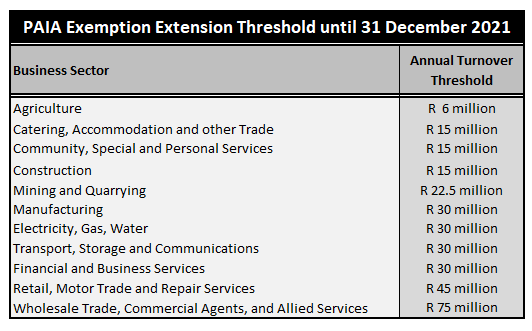
You are probably currently exempt if you are a smaller business, specifically a “private body”, including any private company.
But the exemption does not apply to any non-private company, nor to any private company in any of the business sectors listed below with either –

Even if the deadline is once again extended, you will almost certainly still have to comply somewhere down the line, and at least by getting this done now you have got rid of one annoying little red tape item from your Action List. Procrastinating, as Hunter S Thompson pointed out, just means having the choice made for you down the line.
Prepare your PAIA manual now; if you already have one, update it regularly.
Disclaimer: The information provided herein should not be used or relied on as professional advice. No liability can be accepted for any errors or omissions nor for any loss or damage arising from reliance upon any information herein. Always contact your professional adviser for specific and detailed advice.
© LawDotNews
Our cellphones have, for most of us, become integrated into virtually every aspect of our lives.
Take a moment now to think of how much damage a cybercriminal, or an industrial spy, perhaps even a malicious stalker or vengeful ex-employee, could do both to you personally and to your business if they succeed in getting spyware onto your phone.
Concerned? Firstly be aware that “spyware on your cellphone” is a real threat, and then act immediately to protect yourself.
A good start is this guide to –
Read “How to find and remove spyware from your phone” on ZDNet.
Disclaimer: The information provided herein should not be used or relied on as professional advice. No liability can be accepted for any errors or omissions nor for any loss or damage arising from reliance upon any information herein. Always contact your professional adviser for specific and detailed advice.
© LawDotNews
A group of Africrypt investors, who lost millions following an alleged hack of the crypto platform earlier this year, say they will only accept an offer from a mystery investor to inject $5 million (R76 million) in the firm if the investor agrees to certain conditions.
This, despite investors with the majority of claims against the platform having voted unconditionally in favour of the offer, following a six-hour virtual meeting on Friday.
The mystery investor, who has not revealed identification details, has offered to put in the money for a 51% stake in the company and in so doing, take it out of liquidation, on condition that criminal charges against the platform’s founders Raees and Ameer Cajee are dropped.
The brothers have been in hiding since informing investors in April that the platform had been hacked.
The liquidators’ attorney, Ruann Kruger, confirmed in an e-mailed letter to creditors today that those investors representing 69% of the total ascertainable claims at the time voted in favour of the offer unconditionally.
However, creditors who made up 21% of claims voted in favour of the compromise subject to the implementation of additional terms and conditions that were put to the provisional liquidators during the meeting. The remaining 10% of the creditors rejected the offer.
To enable the provisional liquidators to properly verify each claim, creditors have been asked to provide full details and proof of each claim by Friday.
Attorney Darren Hanekom, who is representing a number of creditors, says the additional terms and conditions include that the settlement is no longer conditional on the investors withdrawing their criminal cases.
Hanekom says further protection mechanisms were also put in place regarding the mystery investor’s contractual obligations to the business.
“We await confirmation as to whether the amendment version has been accepted; thereafter, it will need to be made an order of court.”
Article by: itweb.co.za
In what has been described as a “get out of jail free” card for the Cajee brothers, the liquidators for failed crypto scheme Africrypt say an unnamed investor has proposed stumping up US$5-million (about R77-million) for a 51% stake in the company – provided all criminal proceedings against the Cajees are dropped.
Creditors get to vote on the compromise offer on Friday, 12 November.
One creditor, who asked not to be named, described it as an “audacious” offer.
As Moneyweb previously reported, Raees and Ameer Cajee, have a history of ‘hacks’ against their various crypto schemes, the first being in May 2019 and then again earlier this year when an amount of about R200-million was allegedly hacked and spirited away.
Though the Cajees have stuck to the hack story, forensic investigators are less sure.
The compromise offer presented to creditors proposes paying $4-million (R61.6-million) towards the payment of creditor’s claims, which are reckoned to amount to about R200-million, and a further $1-million (R15.4-million) as capital for purposes of continuing the business.
The unnamed investor willing to inject $5-million into the business will receive 51% of the shares in Africrypt, with the balance of shares going to creditors pro rata to the balance of their claims.
The proposal also calls for the hiring of the two Cajee brothers by the company. In addition, it calls for one of the liquidators, Eugene Januarie, is to be appointed to the board, alongside an appointee representing the investor.
One of the conditions of the offer is that any criminal charges laid by creditors against the Cajees be dropped, and that they agree to alternative dispute resolution instead.
Ruann Kruger, legal representative for the liquidators, said he did not want to comment on the compromise offer ahead of the Friday meeting with creditors.
One creditor, who asked not to be named, described the offer as “preposterous”.
“It’s a ‘get out of jail free card’ for the Cajees. Who would invest in a business like this as if it had any credibility or chance of success, other than someone very close to the Cajee family?”

There is still no certainty as to the value of claims against Africrypt, and the figure of R200-million given by the liquidators represents the deposit amounts, not the subsequent value of the cryptos deposited.
Bitcoin is up roughly 200% over the last year, and ethereum more than 1 000%. It means investors in Africrypt – who were being offered 10% a month – have potentially lost hundreds of millions of rands.
The offer requires 75% support from creditors to be accepted, at which point it will be made an order of court.
Another creditor said the offer is likely to be accepted by 75% of creditors, as the alternative is to receive nothing.
This proposed compromise certainly comes at a convenient time considering the current prices of bitcoin and ethereum
While creditors will sign away their rights to pursue criminal charges against the Cajees if they vote in favour of the offer, law enforcement authorities and ordinary citizens may take a different view.
The Cajees were living the high life prior to the collapse of their companies and, despite being in their early 20s, appeared to have enough money to purchase several luxury cars and houses – and then boast about it on social media.
“This proposed compromise certainly comes at a convenient time considering the current prices of bitcoin and ethereum,” says attorney Darren Hanekom, who is representing a number of creditors. “We trust that the general body of creditors will make the right decision when the proposal is tabled for a vote.”
Article by: Moneyweb
“[The Ombud} has been given wide inquisitorial powers whereby such disputes can be resolved as informally and cheaply as possible by means of qualified conciliators and adjudicators, without the need for legal representation, save in certain limited circumstances.” (Extract from first judgment below)
If you have a dispute with anyone in a “Community Scheme” – sectional title, Homeowners Association (HOA) or the like – remember that your first port of call should be the CSOS (Community Schemes Ombud Service).
Disputes are inevitable in any community situation, with sources of conflict ranging from noise issues to problem pets, common area usage disagreements, parking space complaints and so on – the list is endless. Another perennial battleground is owners fighting with administrators (normally a body corporate or Homeowners Association) over levies, rules and regulations, and the like.
The Ombud’s mandate here is wide, with the CSOS promising “affordable, reliable justice” via its conciliation and alternate dispute resolution process for anyone party to, or “materially affected by” any of a wide range of disputes including levy disputes, nuisance complaints, repairs and maintenance disputes, complex meetings, financial, governance and management issues, exclusive use rights and the like – the list is long and widely-worded.
Costs are low and the process is straightforward, with legal representation restricted to cases where the adjudicator and all parties agree to it or where the adjudicator decides that a party cannot deal with the adjudication without it. There are media reports of the CSOS struggling in practice to provide the quick and reliable service promised on its website, but all in all, it should generally be your first port of call. In fact the High Court has now warned that you will almost always have no choice in the matter.
The High Court has now stated categorically that, whenever the CSOS has the power to adjudicate a dispute, you have to go that route first and can only go direct to court in exceptional circumstances –
Arrear levies – when can the Ombud help with collection?
Our courts have held that the Ombud can assist with the collection of arrear levies or contributions, but only where there is a dispute involved.
Thus (to quote from a 2017 High Court judgment): “If the claim for arrear levies or contributions is not disputed, for example if an owner simply ignores a demand for payment or simply refuses to pay, without disputing the amount of the claim or the proper determination of the levy, the Body Corporate can institute legal action in court to recover the arrear levies from the owner … If, on the other hand, the amount of the levy is disputed because it was not properly determined and this dispute is raised after the defaulter had received a demand, the appropriate forum for recovery of the levies would be the regional office of the Ombud service.”
To avoid any mis-steps here, seek professional advice before deciding when and how to take community scheme disputes to the Ombud.
Disclaimer: The information provided herein should not be used or relied on as professional advice. No liability can be accepted for any errors or omissions nor for any loss or damage arising from reliance upon any information herein. Always contact your professional adviser for specific and detailed advice.
© LawDotNews